



How to Import Emails into Your Family Calendar
About the App
Let Co-parenting be your personal secretary. Turn school emails into calendar suggestions and set up automatic forwarding from your inbox.
Here you'll find articles addressing the life of parents and children during and after a separation. Insightful advice and resources to support you in creating a secure and loving environment for your children.

Collaboration is the key to success. Explore our articles on parenting, agreements, and conflict resolution for inspiration and motivation.

Here you’ll find articles about various living arrangements for children and the practical challenges that can arise.

What does research say about alternate living? What are the legal considerations? How can you maintain financial stability in a week-on, week-off arrangement? Find the best articles here!

Are you wondering what it’s like to live with parents who have separated? Or maybe you want to read about others who also live under two roofs?

When children live in an alternate living arrangement or have parents in separate homes, it impacts both their own and the adults' health and well-being in various ways.

It’s tough when parents separate, but it can be crucial for everyone’s long-term well-being.

Find a concise overview of the app and how it makes life easier for families living under different roofs.
Let Co-parenting be your personal secretary. Turn school emails into calendar suggestions and set up automatic forwarding from your inbox.
Add school holidays and term dates to your shared family calendar. Learn how to import dates for children at different schools in Co-parenting.
Hostile texts and emails to your co-parent reach your child even if they never read them. Child psychologist Malin Bergström explains why — and what helps.
Learn how TalkSafe scores messages, suggests rewrites and blocks very toxic wording, what strict mode changes, and why your setting stays private.
England
After separation, you may still share responsibility for important decisions about your child. In England, this is called parental responsibility. It is separate from how many nights your child spends in each home.
England
A child arrangements plan explains where your child lives, when they spend time with each parent and how everyday care works. In England, parents can make their own agreement when it is safe to do so. If agreement is not possible, the Family Court can decide.
England
When a court decides arrangements for a child in England, the child’s welfare comes first. That means looking at the child’s actual needs and safety, not simply choosing an equal timetable or deciding which parent has the stronger grievance.
England
If arrangements for your child cannot be agreed, the Family Court can decide where they live, who they spend time with or a specific question such as schooling. Here is what usually happens in England, and what you can prepare at each stage.
England
You do not have to understand every part of the family system before asking for help. In England, start with the problem you need solved: making a plan, understanding a court case, protecting a child or arranging financial support.
England
A clear plan can reduce last-minute messages and misunderstandings. Here is what a parenting plan can cover in England, and how it differs from a court order.
England
A move can change your child’s school journey, contact with a parent and access to support. Before making a firm plan in England, check the existing arrangements and whether the proposed move needs agreement or a court decision.
England
You are allowed to say how living in two homes feels. If you live in England, adults should listen to your views—but you do not have to solve your parents’ disagreement.
England
You deserve care, safety and someone who listens. If something at home feels frightening or hurts you, you can ask for help—even when the person involved is a parent.
England
Child maintenance is money towards your child’s living costs. In England, parents can agree payments themselves or use the Child Maintenance Service. Here is how to choose a starting point, understand the calculation and keep payments on track.
England
When your child stays in both homes, the Child Maintenance Service looks at overnight stays and day-to-day care. These are different questions. An equal number of nights does not, by itself, mean that no maintenance is due.
England
A missed payment can leave an immediate gap in your child’s budget. The next step depends on whether you have a private arrangement or a case with the Child Maintenance Service. Start with the payment record and the type of arrangement you have.
England
When your child lives in two homes, school, the doctor and benefit services may each need updated details. This checklist explains the main address questions for parents in England.
England
The home may be the first worry, but pensions, savings, debts and future living costs also matter. In England, married couples and civil partners have a financial settlement process alongside ending the relationship. People who were not married have different rules.
England
If one income now has to cover your home, start by checking help with rent and Council Tax. In England, most working-age parents making a new claim look at Universal Credit. Some housing situations use Housing Benefit instead.
England
After separation, your child still needs reliable access to their GP, medicines and appointments. In England, begin with their NHS care and the information each household needs. Private insurance, if you have it, is a separate policy to check.
England
A lost job, illness or a child’s care emergency can affect your income in different ways. In England, the payment or leave available depends on why you cannot work. Start with that question, then check any benefits or maintenance arrangement that needs updating.
England
Before deciding how much to save, decide who the money belongs to and when it should be available. A Junior ISA can protect long-term savings for a child, but it is not a fund parents can draw on for school bills or an emergency.
England
After separation, check both the money coming in and the information held on your claims. Child Benefit, Universal Credit and help with housing do different jobs. Shared care does not automatically split each payment between parents.
England
You might feel sad, angry, relieved or unsure what you feel. If you live in England, there are people who can listen. You do not have to wait until things feel unbearable.
United States
Who can choose a school, agree to treatment or change the weekly schedule? The answer comes from the rights set out in your custody arrangement. This guide explains the main terms and how to find the part that answers your question.
United States
A workable schedule tells your child where they will be and tells the adults who is responsible. Here is what a parenting-time plan can cover, how it becomes an order, and what to check when arrangements stop working.
United States
Courts look at how a proposed arrangement will affect the child’s life, relationships and safety. Understanding that focus can make a custody case less confusing, even though the exact legal tests depend on the state.
United States
A custody case usually involves forms, notice to the other parent, possible help to reach agreement and one or more court hearings. This guide explains those stages so you can understand the instructions from your own court.
United States
The right service depends on what needs to happen next: make a parenting plan, obtain a court decision, collect child support or protect a child. This guide helps you distinguish those roles and prepare for a first contact.
United States
A written plan can reduce uncertainty about school weeks, holidays and handovers. In the United States, its legal effect depends on your state and whether the court has approved it.
United States
A move can change school, travel and how often your child sees each parent. The key questions are what the current order allows, what notice is required and whether the proposed arrangements need a court decision.
United States
You can tell adults what living in two homes feels like. In the United States, how a court hears children depends on the state. You are not responsible for deciding your parents’ dispute.
United States
You deserve care and protection from harm. If someone at home hurts you, threatens you or leaves you without the care you need, you can tell a safe adult.
United States
Child support helps pay for the ordinary costs of raising your child, including having a home, food and clothes. Here is how payments are worked out, how to get an arrangement recorded, and what happens when circumstances change in the United States.
United States
A child can spend half their time with each parent and still need a child-support payment between households. The amount depends on the local calculation, both households’ circumstances and the costs covered by the order.
United States
If child support is late or only partly paid, the first useful distinction is whether you already have a support order. Here is how collection works in the United States, what records help, and where to look for help with immediate costs.
United States
If your child lives in two homes, school and tax records need to reflect the right information. In the United States, these services ask different questions. One address update does not settle them all.
United States
The home is only part of the financial picture. Savings, debts, retirement accounts and the history of each asset can all matter. This guide explains the main questions and a practical way to organise the information.
United States
If rent is taking more than you can manage after separation, there are several possible housing programmes. They have different applications and waiting lists. Here is how to find the right starting point and prepare the information it needs.
United States
The priority is to know that your child is enrolled, which care the plan covers, and what each household will pay. A court order about insurance and the insurer’s enrolment records are separate things.
United States
When earnings fall, there are three separate questions: can you take time off, will any money replace your pay, and will health coverage continue? This guide explains the main routes so you can check the part that fits your situation.
United States
Before choosing an account, decide what the money is for and who should control it. A parent’s savings, a gift held for a child and a 529 education plan have different ownership and withdrawal rules.
United States
If money is tight after separation, begin with the bill that cannot wait. Food, healthcare, housing, lost earnings and child support have different routes. You do not have to understand every programme before making a first enquiry.
United States
You may be worried, angry, relieved or not sure what you feel. If your parents are separating, you can ask someone to listen. You do not have to handle it alone.
Canada
Who chooses the school? Who can agree to treatment? Who handles the ordinary decisions during a child’s stay? In Canada, the answers depend on the applicable law and your parenting arrangement. The federal Divorce Act separates major decisions from day-to-day care.
Canada
A parenting plan works best when it explains the child’s ordinary week as well as holidays. In Canada, families use agreements and court orders to set out care after separation. The details should fit the child’s needs, safety and practical circumstances.
Canada
A parenting decision should fit the child in front of the court. Under Canada’s Divorce Act, the child’s best interests are the only basis for a parenting decision, with their safety, security and well-being given primary consideration.
Canada
If you cannot resolve a parenting question, a court can make a decision about your child’s care. In Canada, the forms and steps depend on the province or territory and the type of case. This guide explains the main stages and how to find the right local process.
Canada
You may need someone to explain paperwork, help with a parenting plan or respond to a safety concern. Canada’s family justice services vary by province and territory. Start with the job you need help doing, then find the service that handles it locally.
Canada
A parenting plan puts the everyday arrangements in one place. For families in Canada, a useful plan explains both the weekly routine and how bigger decisions will be made.
Canada
A move that disrupts a child’s relationships can need more than an address update. Under Canada’s Divorce Act, relocation has specific notice and objection rules. Check the applicable law and existing orders before treating a proposed moving date as settled.
Canada
You can say what life in two homes feels like. If you live in Canada, adults should listen to your views. You do not have to settle the disagreement between your parents.
Canada
You deserve care and protection from harm. If something at home hurts or frightens you, you can ask for help. You do not need to know the law before talking to a safe adult.
Canada
Child support helps cover a child’s costs after parents separate. The amount depends on the rules that apply to your family, income and parenting arrangements. Start with the applicable guidelines, then work out how payments will be recorded, updated and collected.
Canada
Both homes have costs when a child spends substantial time with each parent. Under Canada’s Federal Child Support Guidelines, shared parenting does not automatically cancel support or make subtracting two table amounts the final answer.
Canada
If child support is missing, start with the order or written agreement and a record of payments. Every Canadian province and territory has a service that can help enforce support. The enrolment rules and name of that service depend on where you live.
Canada
When a child lives in two homes, several services may need updated information. In Canada, school, health coverage and child benefits each have their own process. Here is a checklist to work through.
Canada
The rules for dividing property in Canada depend on the province or territory and whether you were married. Begin by identifying the applicable rules, listing the assets and debts and checking deadlines. Ontario provides one useful example of how a system can work.
Canada
If your new household cannot cover the rent, check housing assistance where you live. In Canada, many programs are delivered by provinces, territories and local organisations. Eligibility, waiting lists and available help depend on your location and circumstances.
Canada
Keep three things clear after separation: your child’s public health coverage, any additional insurance and the plan for appointments and medicines. In Canada, public coverage is managed by the province or territory, while extra benefits may come from another program or an employer.
Canada
When earnings stop, the right support depends on why you cannot work. Canada’s Employment Insurance has different benefits for job loss and medical absence. Check those alongside employer benefits, local assistance and any family payments that need updating.
Canada
A Registered Education Savings Plan can help save for education after high school. After separation, the practical questions are who controls the plan, how contributions are coordinated and what happens when the child needs the money.
Canada
The Canada child benefit is a monthly government payment for eligible families with children under 18. After separation, who receives it and how much they receive depend on the child’s care arrangements, household income and the other eligibility rules.
Canada
Changing homes or hearing your parents argue can feel like a lot to carry. If you live in Canada, you can ask someone to listen—even when there is no emergency or court case.
Photograph a school notice, forward an email, or import school term dates — the AI fills in the shared co-parenting calendar while you just check and save.
Summer planning when you share custody: start early, agree on the holiday weeks, swap days when you need to, and balance old traditions with new ones.
Psychologist Maria Farm and journalist Lisa Bjärbo wrote a Swedish-language book about everyday life after separation. In this interview, they explain why they wanted to discuss the questions that keep returning as children grow, from money to routines and new family relationships.
How do families in Sweden live every other week? Read our report on shared custody: background, regional differences, and family finances. In Swedish.
Sweden
You deserve care, respect and protection from harm. In Sweden, adults are not allowed to hit children or treat them in a degrading way. You can ask for help if home feels unsafe.
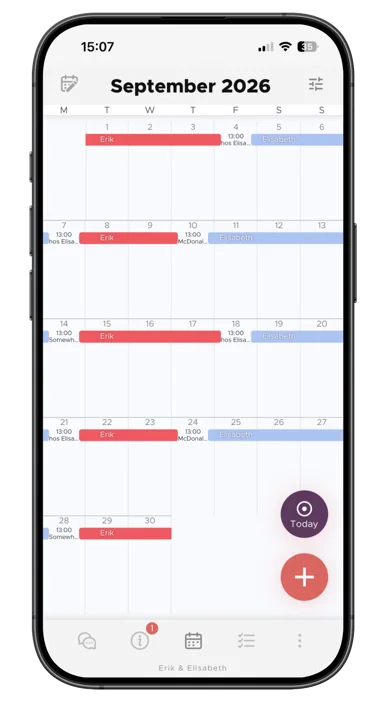
See the whole month at a glance, build your child's living schedule, and keep both homes in sync. How the Co-parenting shared calendar works.
Separating with children? A checklist of what to sort out first: where everyone lives, the schedule, handovers, money, sick days, and what to tell the kids.
What to say when your child asks if you still love each other, or who wanted the divorce. Example answers to six tough questions, from a child psychologist.
Living in two homes can feel good sometimes and difficult at other times. You might enjoy time with each parent and still hate packing. You do not have to choose one feeling, and you do not have to make the arrangement work on your own.
The Swedish term växelvis boende describes a child living alternately in each parent’s home. One useful idea in the original discussion by child psychologist Malin Bergström is to look beyond visits: what ordinary care and relationships does the child need to keep?
Sweden
A child can live in two homes but have only one registered address in Sweden. Skatteverket decides that registration. Here is how it works when parents live apart.
See how the Co-parenting app works: a shared hub for your children's calendar, chat, lists and expenses, plus how to sign up and invite your co-parent.
How to talk to your co-parent about the children without it turning into a fight: treat each other as colleagues, agree what you discuss and how often.
Most children do well living in two homes, research shows, though not all. What researchers say about alternate living and how to talk to your parents.
If your parents are getting divorced, it is never your fault, and things do get easier. Ideas for finding calm, a safe place of your own and a new normal.
Sweden
You do not have to handle every worry on your own. In Sweden, you can talk to a safe adult, contact Bris or use another youth support service about what your parents’ separation is like for you.
Sweden
You can tell adults what life in two homes feels like. In Sweden, your views matter. You do not have to choose a parent to keep someone happy or solve the adults’ disagreement.
If your parents are divorcing, you don't have to pretend everything is fine. Advice for kids on parents who ask too much, badmouth each other, or fight.
For children and teenagers: why parents get angry, sad, restless or shut down after a divorce, what the feelings mean, and why things usually calm down.
When parents get divorced, life can feel a bit upside down for a while. It can help to know the stages most families go through — and that things usually get easier and better in the end.
Agreeing on a shared message about your separation can feel awkward, but it means you back each other up publicly — even if you feel deeply betrayed inside (that's okay). Here are tips for simple, clear communication that reassures your children and you.
Telling your children about a separation is hard. Child psychologist Malin Bergström on when to tell them, what to say and how to handle the days after.
Children need to hear that things will get better. Child psychologist Malin Bergström on how to give your child hope while you get through a divorce.
How to make your child feel at home after separation: involve them in the move, create their own corner, and handle a smaller home without a spare room.
When a parent disappears from a child's life, the child still needs answers. Child psychologist Malin Bergström on how to talk about an absent parent.
It's natural for a child with two homes to miss a parent. How to acknowledge the longing, when to allow a call or an extra night, and how to stay calm.
A separation brings real losses: your identity as part of a couple, financial security, the nuclear family. Psychologist Malin Bergström on facing them.
Taking care of yourself matters during a separation. Four calm questions to check in with yourself, plus small routines for home, food, exercise, and work.
Sweden
Sole custody in Sweden usually means you make the important decisions about your child’s personal affairs. A move still needs to take account of the child’s needs and any existing contact arrangements.
Sweden
A move can change your child’s school, travel and daily care. If you have joint custody in Sweden, important decisions about the child generally need both custodians’ involvement.
Sweden
Equal time does not always mean equal resources. In Sweden, a parent may still need to pay child maintenance when the child lives with both parents, especially when their finances differ significantly.
Practical tips for smoother transitions between two homes: packing together, warm welcome-home routines, and what to do if your child resists the move.
Good communication is the backbone of co-parenting — but sometimes one or both parents cross the line of what's acceptable, occasionally or as a recurring pattern. How do you tell ordinary disagreement from real insults, and when does it become destructive?
Practical ways to reduce conflict with your co-parent: keep your agreements, use I statements, stay out of their parenting and help out when you can.
Practical examples of 7+7, 2-2-3 and other parenting schedules, with questions to help you find a routine that works for your child.
How should your child live after a separation — alternating weeks, another split, or one main home? Here's what matters most when you decide.
It is common for a child to prefer one parent, and it is usually a phase. Why it happens, and what helps both the favorite and the left-out parent.
Co-parent not answering your invitation, or saying no to the app? Find out why, start using it yourself, and see other ways to get cooperation going.
Cancel your Co-parenting subscription step by step via the App Store or Google Play, delete your account, and see why deleting alone doesn't stop billing.
TalkSafe reads tone, not just words: it catches belittling, irony and veiled threats, suggests kinder rewrites and blocks the worst messages outright.
Add practices, dentist visits, and packing notes once — your co-parent, the children, and anyone else who needs to know sees them right away.
How the Packing List, Lists and To-Dos work in the Co-parenting app: check off what the child takes between homes, share wishlists and split tasks.
Keep every message about the kids in one place. How chat threads and visibility work, and how the TalkSafe AI filter stops toxic messages before they send.
Share photos, clothing sizes, vaccinations and account logins with your co-parent in one place, so both homes stay up to date without having to ask.
Some children cope with a separation by becoming extra responsible and high-achieving. What it looks like, why it happens, and how to help them relax.
Divorce can make it hard for a child to concentrate at school. Why schoolwork suffers, how to help with homework, and when to ask the school for support.
Quiet children and teenagers who withdraw are often struggling to find the words, not shutting you out. How to build trust without pushing them to talk.
Teenagers pull away after a separation but still need limits. How both parents can keep track, set shared boundaries, and stay close to their teen.
Angrier child since the separation? Anger is often masked grief. A child psychologist explains why tantrums increase and how to set limits and stay close.
Trouble sleeping, a lost appetite or stomach aches after a separation are common. Child psychologist Malin Bergström on how to help your child feel better.
Sadness, worry and depression are common when parents separate. Learn how to spot what your child is grieving, open a conversation and give real hope.
Sweden
Familjerätten is the municipal family law service. If you are separating in Sweden, it can help explain parenting options, support discussions and assist with certain agreements about your child.
Sweden
If the other parent pays too little maintenance or none at all, Försäkringskassan may be able to help. Its maintenance-support benefit is called underhållsstöd.
Sweden
Child maintenance helps pay for your child’s everyday needs. In Sweden, the amount depends on the child’s costs and what each parent can afford, rather than a fixed percentage of salary.
Sweden
If your income is low, bostadsbidrag may help with housing costs. Children can sometimes count even when they stay part-time. New rules apply from January 2027.
Sweden
You do not have to check every payment at once. In Sweden, start with the costs or care needs that are hardest to manage: housing, everyday child costs, missing maintenance or extra care.
If your child ignores you or only wants the other parent, it's usually a way of coping — not rejection. A child psychologist explains how to respond.
Is your co-parent speaking badly about you in front of the children? Child psychologist Malin Bergström on how to respond and help your child cope.
Conflict between separated parents hurts children of every age, and anger and disappointment weigh on the whole parent-child relationship. The good news: you don't have to accept the arguing — there are concrete steps you can take to reduce conflict and keep new fights from starting.
Get more out of the Co-parenting app: sync the shared calendar with your own, build a private photo album for the kids, and find articles worth reading.
How do children react to divorce? Child psychologist Malin Bergström explains common reactions, why they come in waves, and how you can support your child.
When should a new partner meet your children? Advice on timing, telling your co-parent first, keeping the focus on your child, and how bonus families work.
Co-parenting gets easier once the couple relationship is truly over. Child psychologist Malin Bergström on grief, triggers, forgiveness and moving on.
When a separation turns into a crisis, self-care matters. Psychologist Malin Bergström on sleep, food, alcohol, moving your body, and asking for help.
Separation is a crisis for most people. Child psychologist Malin Bergström explains the warning signs, common reactions, and why being left hurts most.
Is living every other week good for children? The upsides kids themselves mention: more time with both parents, more adults around, and a calmer home.
Silence between parents is a conflict too. How permafrost between co-parents lands on the child, and what you can do to get communication going again.
How do you put your child first when your own life is in crisis? Child psychologist Malin Bergström on acknowledgment, hope, and staying a parenting team.
Sweden
When your child lives in two homes, it helps to know which insurance covers what. In Sweden, home insurance, school accident cover and private child insurance do different jobs.
Moving in with a new partner brings together different incomes, children’s needs and existing commitments. A useful budget makes those commitments visible and explains which costs you are choosing to share. It does not need to make every contribution identical.
Sweden
Before adding to your child’s savings, check whose money it is and who can manage it. In Sweden, an account belonging to the child works differently from money saved in a parent’s name.
You do not need to discuss every purchase. You do need a clear picture of regular payments, agreed extra costs and what each household can afford. A small, predictable system can make money conversations easier after separation.
Sweden
Job loss or illness can put extra pressure on a one-parent budget. In Sweden, unemployment benefit, sick pay and private insurance have different rules. Start by checking which kind of support fits the change.
Sweden
If you cannot agree about custody, where your child lives or contact, the district court can decide. Here is how the Swedish process usually works, one stage at a time.
Sweden
Bodelning is the Swedish process for dividing certain property after a relationship ends. The starting point is whether you were married or living together as sambor.
Sweden
If a child does not live with one parent, contact can mean visits, overnight stays or calls. In Sweden, the arrangement should fit the child’s needs and be safe for them.
Sweden
Choosing a school, arranging healthcare and planning your child’s home can raise different questions after separation. In Sweden, legal custody explains who is responsible for important decisions.
It's hard for children when their parents argue. Even when conflict can't be avoided, you can help your child feel safe and make sense of what's happening — child psychologist Malin Bergström explains how.
All children are affected when their parents are in conflict, silent moods included. A child psychologist on the signs and how to protect your children.
Can both parents come to the school play? How to take turns at your child's activities, graduations and holidays after separation — without the tension.
Children have the right to know what's happening in their lives and to say what they think about decisions that affect them. But it's the parents' job to make wise decisions that fit the child — with the child's wishes carrying more weight as they grow.
Can a baby live in two homes? Child psychologist Malin Bergström on overnight stays, attachment to both parents and building up time with each of you.
Research often finds that children sharing time between homes do as well as, or better than, children living mainly in one home. But that does not prove that a particular timetable causes better well-being. Here is what published studies can tell parents—and what they cannot.
Clothes, football boots, and toys that travel between two homes. Get a checklist of routines and packing habits so your child's things stop going missing.
Shared routines make life in two homes calmer for a child. Advice on bedtimes, food, screen time, gifts and holidays when you and your co-parent live apart.
Sweden
A parenting decision should work for the child’s real life. In Sweden, the court looks at safety, care, important relationships and the child’s views when deciding custody, residence or contact.
Sweden
A clear plan can make handovers and everyday decisions easier. In Sweden, a practical parenting plan and an officially approved agreement have different purposes.
Child psychologist Malin Bergström shares simple ways to support your child through a separation: closeness, cozy moments, laughter and steady routines.
It's hard to be a good parent when your relationship with your co-parent is strained — that's one of the reasons we built the Co-parenting app. Here's how to think about a tough situation, and what you can do to calm things down.
Sibling quarrels often change after a separation. Why children fight more, why some suddenly stop, and what you can do at home to calm things down.
When everyday life changes, planning and clear agreements make everything easier. Priorities vary from family to family, but communication, living arrangements, and logistics are all worth agreeing on — here's how to approach each part before you move on to "Creating Sustainable Agreements".
Your child needs to know they can come to you with anything. How to build trust, listen without defending yourself, and talk about their other parent.
How to strengthen your child's resilience: what it is, and how trust, support and age-appropriate involvement help children cope with big changes.
Parallel parenting means each parent runs their own home and contact stays minimal. Learn how to limit communication and shield your child from conflict.
After a separation, one parent — often the mother — carries most of the practical responsibility for the children, while the other feels their way of caring isn't fully trusted. Rebalancing that takes real effort: one of you may need to step up, and the other to let go.
You don't have to parent the same way to parent well together. What helps your child most is mutual respect, a healthy distance, and a few shared ground rules — so everyone knows roughly what applies in both homes.
Build a co-parenting team after separation: why your different strengths help your child, and how neutral, correct and friendly contact keeps the peace.
Parental cooperation after a separation gives the child security. How to become a parenting team with your co-parent, and what your child gains from it.
What is it really like to grow up in two homes? Matilda, 18, on her blended family, missing a parent, step-siblings and what made her feel safe.
No articles matched your search.
"The turning point came when we found the Co-parenting app. There's less hassle and we both have a better handle on things. It feels so good!"
"A thousand thanks for this app, it has finally got us to communicate!"