





Separation
Checklist: Separating With Children
Separating with children? A checklist of what to sort out first: where everyone lives, the schedule, handovers, money, sick days, and what to tell the kids.
A good parenting partnership starts with truly ending the romantic one. Closing that chapter frees you both to build a new kind of team — one centered on your child's needs and feelings rather than your own.

The first step toward a functioning co-parenting team is to end your relationship as a couple. If you're shocked, angry, or grieving the divorce, it helps to keep what happened to you as a couple separate from your parenting. The person who left may have already detached from the romantic relationship; for the one who experienced the separation as a shock, the process takes longer.
Processing and grieving a breakup can be a long journey, and it often clashes with our society's ideal of moving on quickly. "What, you haven't moved on yet?" someone may ask after six months, expecting a fun single friend to go out with. Emotional pain and psychological healing can live within us for years and cannot be rushed. In the meantime, though, we need to find a way of parenting that works — our child's life can't be put on pause.
To move forward, think of your relationship as two tracks: one for parenting and one for you as a couple. Feelings about your ex as a partner belong on the couple track; matters concerning your co-parent belong on the parenting track. The two tracks have different communication channels, different tones, and different content. The couple track is the part of the relationship you mourn and process. The parenting track is the one you keep and develop — and here, the thinking brain should rule. It must not become a way to get back at someone who hurt you, or a place to ruminate on wrongs and betrayals. The parenting team exists for your child and is built around your child's best interests. The phrase "when they go low, we go high" sums up the attitude that makes a parenting team strong. There is honor in acting properly even when your co-parent can't keep it together.
To avoid getting stuck in the emotions of the breakup, it helps to steer around your triggers. Contact with your co-parent is the obvious one, so aim to make that contact predictable, neutral, and businesslike.
Well-meaning friends and relatives may want to take your side and confirm how badly you were treated. If you explain that you appreciate their concern but are working on staying loyal to your co-parent, they'll understand what kind of support you actually need.
It also helps to anticipate difficult situations. Parties and dinners where you're the only single person can leave you feeling abandoned — maybe you want a cooling-off period before you pick that part of your social life back up.
Children can trigger these feelings too. They long for their other parent, and they stop cooperating the moment anything gets the least bit stressful. Since those situations are unavoidable, it helps to decide ahead of time what you'll say and do — and to practice, so you feel less emotionally pressed. Try phrases like "I know you miss Dad. Tomorrow you'll see him and have a lovely time — but right now, I'm going to comfort you." Or "Yes, Mom is much better at braids. So you and I are going to practice until we're good at it too."
Forgiveness is about letting go of the past and putting your energy into the present and the future. In that sense, forgiving your ex is essentially a selfish process — it helps you detach and move on.
Forgiveness may sound practical and worth striving for, but it cannot be rushed. It requires grieving and turning your experiences over until they no longer hurt or weigh on you. It's less about actually saying "I forgive you" than about coming to peace with what happened.
Nor does forgiveness mean excusing behavior. You can forgive — perhaps because you realize the other person couldn't do better, was struggling, or was immature — without excusing lies, infidelity, or betrayal.
From your child's perspective, forgiveness helps because it creates calm in you and in your relationship with the other parent. But forgiveness belongs to the couple relationship; it isn't decisive for your child. Effective cooperation and working communication in the parenting team don't depend on forgiving or excusing each other — they depend on separating parenthood from the couple relationship.
Forgiving someone else can be hard, but for some of us the hardest person to forgive is ourselves. It's common to say and do things in the midst of turmoil that we later regret. Be patient with yourself. You are only human, and you're going through a difficult time. Reacting childishly or selfishly in a crisis is human and says nothing about who you are at a deeper level — and it doesn't mean you'll keep functioning at that low point. What matters isn't each individual thing you've said or done, but that you can reflect on it and find ways to do things differently in the future.
Trust that your relationship with your child is unique. There is no other relationship that gives you as many chances to repair, set things right, apologize, and start over.
Parenting lets us meet in the tough times and move forward together — and fall back again. Someone once said that fading a person out of your life takes as long as the time you lived together. In practice, couple relationships rarely end as neatly as they do in theory, and "over" doesn't always mean completely over. Parents stay each other's emergency contacts, cook for each other, and fix each other's cars long after moving apart. We call each other when things are hard, and sometimes still sleep together even though we've broken up. And if our co-parent meets someone new, we suddenly decide it's not too late after all and want to outshine the newcomer. We rarely talk about how messy separation really looks, but it's actually normal. Even if the process wavers, you can still work toward a stable parenting team.
Malin Bergström Child psychologist, associate professor and author
27 August 2026
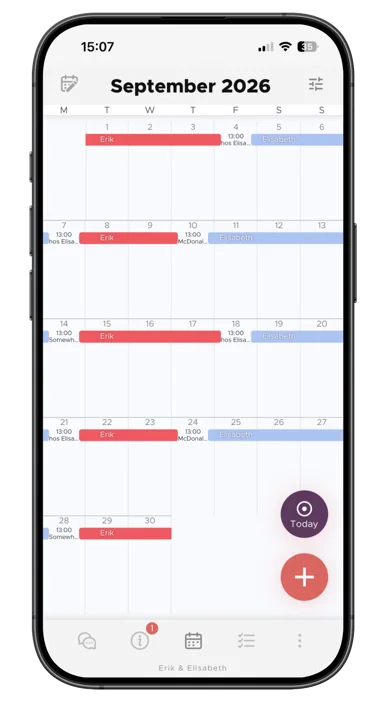
"The turning point came when we found the Co-parenting app. There's less fuss and both of us have a better handle on things. It feels so great!”
"Thank you so much for this app, it has finally gotten us to communicate!”

Separation
Separating with children? A checklist of what to sort out first: where everyone lives, the schedule, handovers, money, sick days, and what to tell the kids.

Separation
What to say when your child asks if you still love each other, or who wanted the divorce. Example answers to six tough questions, from a child psychologist.

Separation
Telling your children about a separation is hard. Child psychologist Malin Bergström on when to tell them, what to say and how to handle the days after.