





Cooperation
How Toxic Messages to Your Co-Parent Affect Your Child
Hostile texts and emails to your co-parent reach your child even if they never read them. Child psychologist Malin Bergström explains why — and what helps.
You don't have to parent the same way to parent well together. What helps your child most is mutual respect, a healthy distance, and a few shared ground rules — so everyone knows roughly what applies in both homes.

When researchers interviewed recently separated parents, many described the freedom and joy of finally parenting their own way, without having to compromise. That feeling is worth cherishing. The art is to also build the kind of communication that carries your children between you and your co-parent. Creating a healthy distance from the other person's parenting can be hard. Few of us have the privilege of absolute trust in each other, and it's natural to get caught up in fantasies about what might be lacking in the other home — that the other parent is emotionally absent, a poor cook, unable to keep the child's routines, or that the child is longing for you. Fantasies like these drain your energy.
You cannot influence how your children have it in their other home without your co-parent's blessing, so you have to train yourself to let go. Trust that the other parent will grow into their role — or find ways to communicate so you can share your concerns and, hopefully, be reassured.
To make this easier, agree on how much insight you each get into the other's parenting, and how much right you have to comment on it. The same rules must apply to both of you. A basic rule is to respect each other's privacy when it comes to what happens in the other home and during the other parent's time with the child. If one of you needs more distance and clearer boundaries, that need takes precedence. Later, once your parenting team is established, the boundaries can loosen.
Even parents who live together do things differently. Kids know their parents aren't equally willing to hand out ice cream after dinner, even when the fridge is in a shared home. Over time, the differences between your two homes will probably grow. You are each developing in your own direction, and the kids get used to the fact that you don't do things the same way. The upside is that they gain broad experience and can find their own path with the help of your different interests, standpoints, and perspectives on the world.
If the gap between your homes becomes too wide, however, it can confuse your children and make them feel insecure. Too much of their energy goes into adapting to your different standards.
Consistent routines often help young children. It makes sense, for example, to give up the pacifier in both homes at the same time. Common rules can also reduce the risk of teenagers playing you off against each other to dodge boundaries altogether.
Base the rules between you on what works best for your child. Some children need the security of consistent routines. Others are more bohemian and enjoy that things work differently in each home. Can they handle the fact that you do and think differently? Would they feel better if you compromised and aligned more? Coordinate by keeping an ongoing conversation about your child's needs and stages of development.
In Sweden, municipal family law services (familjerätten) offer voluntary cooperation talks about children after separation. The service assesses whether talks are suitable and safe; concerns about violence or abuse require particular attention. A child-protection concern is handled by social services (socialtjänsten) under a separate process. A report prompts an immediate protection assessment and normally a decision within 14 days about opening an investigation. It does not automatically mean that a full investigation has begun.
Malin Bergström Child psychologist, associate professor and author
17 September 2026
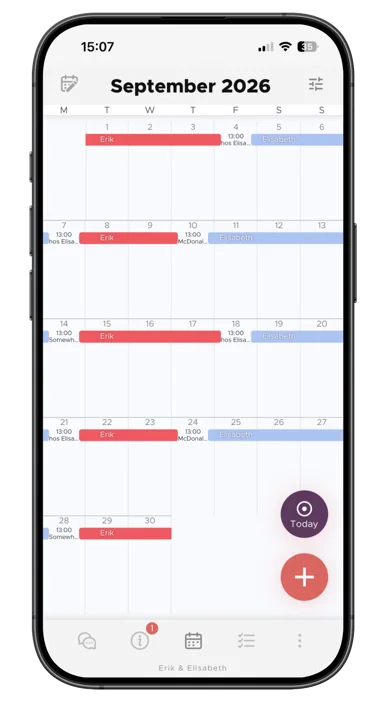
"The turning point came when we found the Co-parenting app. There's less fuss and both of us have a better handle on things. It feels so great!”
"Thank you so much for this app, it has finally gotten us to communicate!”

Cooperation
Hostile texts and emails to your co-parent reach your child even if they never read them. Child psychologist Malin Bergström explains why — and what helps.

England
Cooperation
A clear plan can reduce last-minute messages and misunderstandings. Here is what a parenting plan can cover in England, and how it differs from a court order.
United States
Cooperation
A written plan can reduce uncertainty about school weeks, holidays and handovers. In the United States, its legal effect depends on your state and whether the court has approved it.
Canada
Cooperation
A parenting plan puts the everyday arrangements in one place. For families in Canada, a useful plan explains both the weekly routine and how bigger decisions will be made.

Cooperation
Summer planning when you share custody: start early, agree on the holiday weeks, swap days when you need to, and balance old traditions with new ones.