





Cooperation
How Toxic Messages to Your Co-Parent Affect Your Child
Hostile texts and emails to your co-parent reach your child even if they never read them. Child psychologist Malin Bergström explains why — and what helps.
Good communication is the backbone of co-parenting — but sometimes one or both parents cross the line of what's acceptable, occasionally or as a recurring pattern. How do you tell ordinary disagreement from real insults, and when does it become destructive?

Old destructive patterns often carry over into the new parenting relationship after a separation. Sometimes one parent consistently targets the other; in other cases, both parents overstep. Whatever the reason for the insults, they affect more than the targeted parent — they also affect the children.
Insults and hostility between parents can be distressing for children. It can hurt to see or hear one parent attack the other, even when the behaviour does not meet the legal definition of a crime. Sweden also has a specific offence, barnfridsbrott, introduced in 2021: it concerns a child witnessing specified criminal acts where the child is or was closely related to both the perpetrator and the victim. It does not make every parental argument that a child hears that offence.
Children are deeply affected even when they aren't present during the insults. The targeted parent loses energy, joy, and focus on the child, who ends up feeling neglected. The parents' ability to cooperate around parenting deteriorates, which sooner or later reaches the child. For the child's well-being, the insults have to stop.
Stopping insults that have gone on for a while can be hard. Some parents feel guilty about the situation and believe they have to "take it" when their co-parent behaves badly — perhaps because they were the one who chose to leave, or because they found new love soon after the separation.
On a human level, anger and despair at being left are understandable. But they give no one the right to take revenge through constant insults. The responsibility lies entirely with the person behaving unacceptably.
It makes no difference whether the insults are spoken or written in texts, emails, or elsewhere. Being subjected to this treatment is draining and harmful, and it must end. How to address it in practice varies with the people involved and their circumstances.
In Sweden, conduct can fall under criminal provisions concerning threats, harassment or insults when the conditions of the particular offence are met. Harmful behaviour and a criminal offence are not identical categories. The police investigate suspected crimes, while social services assess needs for protection and support.
In Swedish family proceedings, the court assesses the child’s best interests, including risks of harm and the parents’ ability to put the child’s needs first and take joint responsibility. Repeated harmful behaviour may be relevant to that assessment, but it does not automatically result in sole custody for the other parent. Custody is not a punishment for insulting an adult.
Elisabeth Scholander Family law attorney and mediator, specialized in conflict resolution for families
17 September 2026
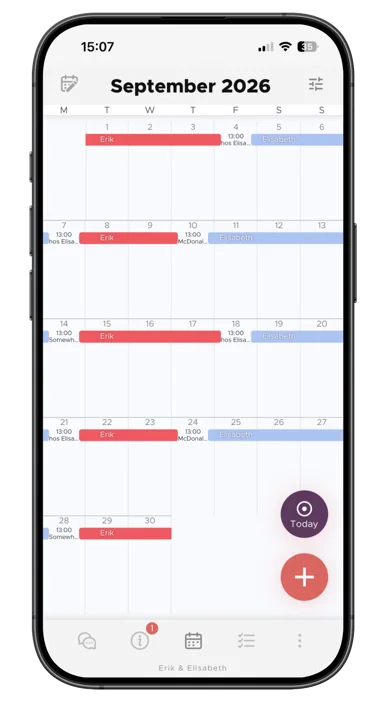
"The turning point came when we found the Co-parenting app. There's less fuss and both of us have a better handle on things. It feels so great!”
"Thank you so much for this app, it has finally gotten us to communicate!”

Cooperation
Hostile texts and emails to your co-parent reach your child even if they never read them. Child psychologist Malin Bergström explains why — and what helps.

England
Cooperation
A clear plan can reduce last-minute messages and misunderstandings. Here is what a parenting plan can cover in England, and how it differs from a court order.
United States
Cooperation
A written plan can reduce uncertainty about school weeks, holidays and handovers. In the United States, its legal effect depends on your state and whether the court has approved it.
Canada
Cooperation
A parenting plan puts the everyday arrangements in one place. For families in Canada, a useful plan explains both the weekly routine and how bigger decisions will be made.

Cooperation
Summer planning when you share custody: start early, agree on the holiday weeks, swap days when you need to, and balance old traditions with new ones.