




England
Youth
Can I Choose Which Parent to Live with in England?
You are allowed to say how living in two homes feels. If you live in England, adults should listen to your views—but you do not have to solve your parents’ disagreement.
In Sweden, many kids whose parents have split up live half the time with each parent, while others stay more with one. Researchers have studied how different living arrangements affect how children feel — here's what they've found.

Living equally with both parents — known as alternate living — is the arrangement most children seem to benefit from the most. It lets you share your whole life with both parents: everyday things like soccer practice, homework, and Friday movie nights, as well as special occasions like birthdays, Christmas, and other fun events.
Forty years ago, nearly all children lived only with their mothers after a divorce, and dads typically saw their kids every other weekend. For many children this meant they "lost" their dad when their parents split up — and that was rarely good for them. When children have caring, responsible parents, it matters that both are actively involved in their lives as much as possible. It's great that children today usually have more contact with both parents, even when it's not an exact 50/50 split.
Sometimes, though, a child does better living mostly with one parent and seeing the other in different ways. Maybe one parent lives far away, or is struggling with personal challenges that make it hard to care for a child right now. In those cases, it's good when other adults can step in and make sure the child is well taken care of.
Sure, living in two places can be tricky at times — like when your favorite toy is at Dad's house while you're at Mom's. But most kids would still rather move their stuff around than see one parent less often.
Researchers have found that what matters most is that the adults in your life can cooperate reasonably well around parenting and back each other up without big conflicts. It's also important that the living arrangement is stable and doesn't change too often. That way, both kids and parents settle into a rhythm where everyone knows what to expect. And if the arrangement does need to change, the new one deserves some time to settle in.
It's worth knowing that research on children's needs and experiences is done at the group level. So while most children benefit from alternate living, there are also kids who can't or don't want to live in two homes. Every child is unique — just like adults — and some simply don't feel comfortable living in two places. That's okay too.
If your current living situation isn't working well for you, you should feel able to tell your parents. Maybe you'd like to start living equally with both of them? Or maybe you'd rather spend a little more time with one parent — say, staying with them from Thursday to Sunday?
In these conversations, your parents should be open to your suggestions and really listen to what you think. They might not always be able (or willing) to do exactly what you want, because of work or other circumstances. But they should truly listen, understand how you feel, and let you say what you think.
We hope this look at what the researchers say was helpful! ❤️
Elisabeth Scholander Family law attorney and mediator, specialized in conflict resolution for families
27 August 2026
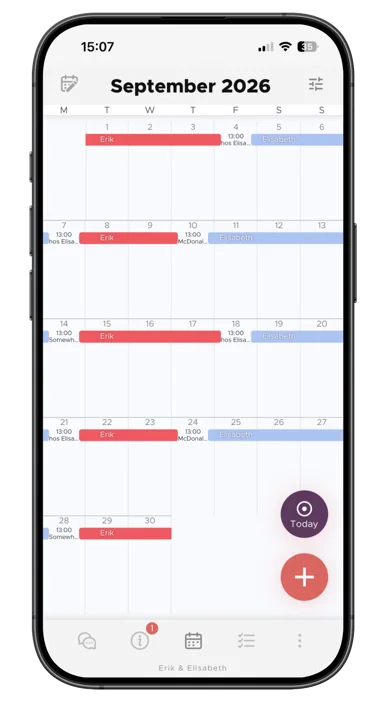
"The turning point came when we found the Co-parenting app. There's less fuss and both of us have a better handle on things. It feels so great!”
"Thank you so much for this app, it has finally gotten us to communicate!”

England
Youth
You are allowed to say how living in two homes feels. If you live in England, adults should listen to your views—but you do not have to solve your parents’ disagreement.

England
Youth
You deserve care, safety and someone who listens. If something at home feels frightening or hurts you, you can ask for help—even when the person involved is a parent.

England
Youth
You might feel sad, angry, relieved or unsure what you feel. If you live in England, there are people who can listen. You do not have to wait until things feel unbearable.
United States
Youth
You can tell adults what living in two homes feels like. In the United States, how a court hears children depends on the state. You are not responsible for deciding your parents’ dispute.
United States
Youth
You deserve care and protection from harm. If someone at home hurts you, threatens you or leaves you without the care you need, you can tell a safe adult.
United States
Youth
You may be worried, angry, relieved or not sure what you feel. If your parents are separating, you can ask someone to listen. You do not have to handle it alone.
Canada
Youth
You can say what life in two homes feels like. If you live in Canada, adults should listen to your views. You do not have to settle the disagreement between your parents.
Canada
Youth
You deserve care and protection from harm. If something at home hurts or frightens you, you can ask for help. You do not need to know the law before talking to a safe adult.
Canada
Youth
Changing homes or hearing your parents argue can feel like a lot to carry. If you live in Canada, you can ask someone to listen—even when there is no emergency or court case.