Division of Property (Bodelning): What You Need to Know

A division of property agreement (bodelningsavtal) formally ends your financial relationship when you divorce or separate, and settles who gets what. Your bank will usually want to see it before either of you can get a new mortgage.

One hand holds a small model house while the other signs papers spread across a desk

What Is the Difference Between Married Couples and Cohabitants?

The difference is significant. If you are married, essentially all property must be divided in the agreement. If you are cohabitants (sambor), only your shared home and the things bought for joint use — furniture, electronics, and so on — are divided.

Why Should I Write a Division of Property Agreement?

Without a signed agreement, either of you can demand a division of property — and assets from the other — several years after the divorce (for cohabitants, up to one year after separation). Once the agreement is signed, neither of you can claim any property or compensation from the other, and your financial ties are cut for good.

There are practical reasons too:

  • Before granting new mortgages, the bank wants to see the division of property agreement.
  • If you buy a new condominium, the housing association wants to see the signed agreement.
  • If you buy a new house or land, the land registry wants to see the signed agreement.

Division of Property If You Were Married

For a divorce, the division of property must be a formal written agreement between the two of you — that is what makes it valid. Do it soon after the divorce: otherwise the right to demand a division of property lingers for a long time after you have separated.

Think through who gets the car, the boat, the cat — and above all, the home. If one of you is taking over a home with a mortgage, check with the bank first that the person staying actually qualifies to take over the loans.

A division of property agreement should always be drawn up in connection with a divorce, but no earlier than the day after the divorce application is filed with the district court (tingsrätten). Draw it up in two identical copies, one for each of you. Agreeing quickly on how to split belongings and money also reduces the risk that a money dispute spills over into arguments and conflict about the children.

Once both of you have signed, the agreement is legally binding and practically impossible to revoke or amend. So read it carefully, and make sure you fully understand what it means and what the consequences are before you sign.

Division of Property If You Were Cohabitants

For cohabitants, the agreement covers only the home and the household goods (furniture, electronics, kitchenware, and so on) bought for joint use while you lived together. Anything you owned before moving in together is not included. Draft the agreement soon after the separation — the sooner you agree, the smaller the risk that disagreements spill over onto the children. As a cohabitant, you can demand a division of property for up to one year after you and your partner separate.

How to Divide Your Property, Step by Step

Here is how the division of property works in practice:

  1. You list everything you own — car, stocks, savings — and its value. Clothes, gifts, and other personal belongings of modest value don't need to be listed; they're yours. If you were cohabitants, you only list the joint property (the home and household goods bought for joint use).
  2. Your partner lists everything they own on the same terms. Valuable hobby equipment is included if you were married.
  3. You each deduct your debts — all debts if you were married, but only debts tied to the joint property if you were cohabitants.
  4. Separate property (enskild egendom) is not included.
  5. Add up both totals and divide by two. You split the surplus, never the debts or loans. After the division, you should each end up with property or cash of equal value.
  6. Then you decide who gets what. As a rule, the owner of an item has first claim to it, but the other person is entitled to half its value. If one of you receives property worth more than the other's share, the difference is evened out with a compensation payment (bodelningslikvid), usually in money.

Linda Ljunggren Syding Family law attorney and CEO of Co-parenting

27 August 2026

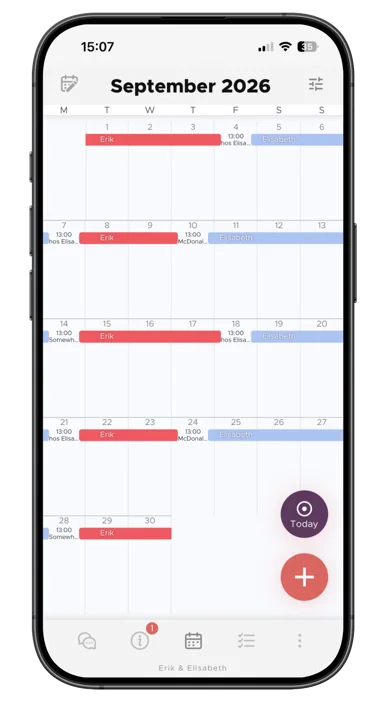
The app's calendar on a phone, showing each parent's weeks with the children as coloured bars

The app that frees up time for what's important

"The turning point came when we found the Every Other Week app. There's less fuss and both of us have a better handle on things. It feels so great!”

"Thank you so much for this app, it has finally gotten us to communicate!”


App ratings: 4.4 on the App Store and 4.7 on Google Play, four of five stars filled on each

Related reading

Research

New Book: "Vardag med Varannan Vecka"

Psychologist Maria Farm and journalist Lisa Bjärbo wrote the book they missed about life in two homes — on money, equality and kids with special needs.

Read article

Research

Living in Two Homes: Why Sweden Is Different

Nowhere is alternate living as common as in Sweden. Child psychologist Malin Bergström on why everyday contact with both parents matters for children.

Read article