





Cooperation
How Toxic Messages to Your Co-Parent Affect Your Child
Hostile texts and emails to your co-parent reach your child even if they never read them. Child psychologist Malin Bergström explains why — and what helps.
Some grown-ups think living every other week is bad for kids — but lots of children with two homes would disagree. Here are the best things about having parents who live in two different places.

When parents no longer live together, one parent often "steps up" and starts doing things the other parent used to handle. That's why children who live every other week often have better contact with their dads than children whose parents live together — dads simply spend more time with their kids and look after them more than before. (And yes, of course, sometimes it's moms who need to step up!)
It can be hard for a parent to do everything alone at home, so many ask for help from grandparents, a best friend, or a neighbor. For you as a child, that often means more adults around — adults with more energy, who are interested in how you're doing.
When you live with one parent at a time, it's often easier to find cozy moments together. Maybe it's always fish tacos on Fridays, because one parent can decide on their own without two adults having to agree on everything? Maybe things get a little more playful and relaxed at home?
This varies from family to family. Some children celebrate their birthday with both parents at the same time, while others get two parties — one with mom and one with dad. Some parents agree on other arrangements, but children who live every other week are often celebrated a little extra, because both parents want to make a fuss of their sweetheart. We think that's a great bonus! The same usually goes for Christmas and presents: celebrating "Little Christmas" with the parent you're not with on Christmas Eve is the best thing ever!
This isn't true for every child, but it is for many. If things were stormy between your parents, the arguing often stops once they no longer live together. That's a good thing — children don't do well when there's a lot of conflict. It's also easier for parents to be kind and steady when everything is calm. Usually both kids and parents feel better for it.
We hope this list helps! ❤️
Malin Bergström Child psychologist, associate professor and author
27 August 2026
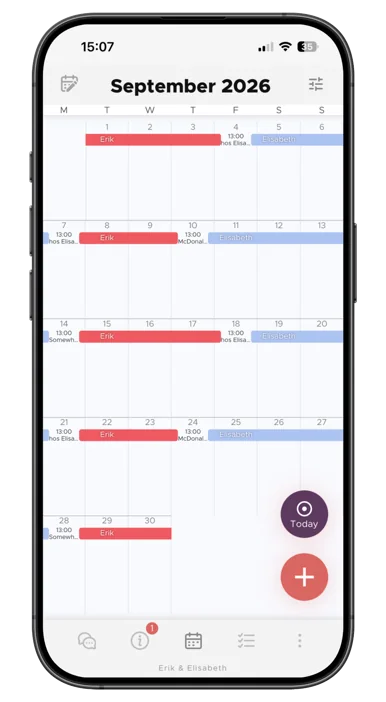
"The turning point came when we found the Co-parenting app. There's less fuss and both of us have a better handle on things. It feels so great!”
"Thank you so much for this app, it has finally gotten us to communicate!”

Cooperation
Hostile texts and emails to your co-parent reach your child even if they never read them. Child psychologist Malin Bergström explains why — and what helps.

England
Cooperation
A clear plan can reduce last-minute messages and misunderstandings. Here is what a parenting plan can cover in England, and how it differs from a court order.
England
Youth
You are allowed to say how living in two homes feels. If you live in England, adults should listen to your views—but you do not have to solve your parents’ disagreement.
United States
Cooperation
A written plan can reduce uncertainty about school weeks, holidays and handovers. In the United States, its legal effect depends on your state and whether the court has approved it.
United States
Youth
You can tell adults what living in two homes feels like. In the United States, how a court hears children depends on the state. You are not responsible for deciding your parents’ dispute.
Canada
Cooperation
A parenting plan puts the everyday arrangements in one place. For families in Canada, a useful plan explains both the weekly routine and how bigger decisions will be made.
Canada
Youth
You can say what life in two homes feels like. If you live in Canada, adults should listen to your views. You do not have to settle the disagreement between your parents.