

Housing & practical matters
Population Registration and Shared Custody
Where should a child with two homes be registered? Learn how Skatteverket decides folkbokföring in shared custody and why the address matters for school.
New to alternating weeks, or have you lived them for years? Here are the most common shared custody schedules — 7+7, 2-2-3, 2-2-5-5 and more — and how to choose one that works for your child, your work life, and the rest of the family.

The line between shared custody and visitation with a parent the child doesn't live with isn't always clear. Beyond how much time the child spends with each parent, other factors matter too: joint legal custody, shared financial responsibility, and whether the child keeps belongings in both homes. Legal precedent suggests that a child who lives with one parent only about 30% of the time is not considered to be in a shared custody arrangement. The schedule examples below — taking time distribution and other circumstances into account — can be seen as shared custody.
This is the schedule most people picture: the child spends seven days with one parent, then seven days with the other. Common exchange days are Monday, Friday, or Sunday.
With only one transition per week, this schedule keeps separations to a minimum. The child has time to settle in with each parent, which brings stability and predictability, and child care and other logistics only need planning once a week. If the exchange falls on a Sunday, Monday, or Friday, the schedule often fits neatly with holidays and long weekends.
For some children, seven days is too long to be away from a parent. A mid-week dinner or a regular activity with the other parent can soften this, and the child can also video-call the other parent or listen to pre-recorded bedtime stories while they're apart.
This schedule may be less suitable for younger children, who need frequent physical contact with both parents. Alternatives that still count as shared custody include the 2-2-3, 3-4-4-3, and 2-2-5-5 schedules.
With a 2-2-3 schedule, the child alternates two days at a time with each parent from Monday to Thursday, then spends every other weekend, Friday to Sunday, with each parent.
The child keeps close, regular contact with both parents during the week and still gets substantial weekend time with each. This schedule often works well for younger children for whom a 7/7 split means too long away from one parent.
Frequent exchanges bring their own challenges: hard goodbyes, more child care coordination, and belongings that constantly need moving. Some parents and children find this schedule chaotic and hard to keep track of. If so, consider Schedule 3, the 2-2-5-5, for a more balanced approach.
Like the 2-2-3, this schedule gives the child regular contact with both parents during the week and extended time with each parent every other weekend.
After the weekend, the child stays on with the same parent through Monday and Tuesday, which reduces transitions and adds stability. The child also has fixed days with each parent every week, which makes planning activities easier. The main difference from the 2-2-3 is that the child's weekends alternate on a steadier rhythm.
In this schedule the child has fixed days with each parent every week, except for one day that alternates between them. If the switch falls on a Monday, the child spends weekends with one parent and weekdays with the other. If it falls on a Wednesday, the child shares the weekend between both parents from Friday to Sunday.
This schedule is predictable and makes it easy to coordinate the child's activities, with each parent handling different parts of the week. It suits parents who work weekends and need the child to be with the other parent during those shifts.
Spending time with both parents across the weekend also allows for shared leisure and downtime, and balancing weekdays and weekends means neither parent becomes the "fun weekend parent" or the "boring weekday parent." As always, the most important factor is what works best for your family.
The following options give the child less than equal time with both parents. As mentioned above, a schedule with less time in one home can still count as shared custody, depending on the circumstances.
This schedule resembles the 7+7 arrangement, with weekly shifts but one day less with one parent. Starting on a Monday, the child stays with one parent until the following Tuesday, then with the other parent from Tuesday to Sunday.
The pros and cons mirror those of the 7+7 schedule. This setup is often a step in a gradual move toward fully shared custody.
The child stays with one parent from Monday to the following Wednesday, then with the other parent from Wednesday to Monday (if the schedule starts on a Monday).
This schedule suits children who want to live with both parents but need more time with one of them — for example, children with special needs who rely on one parent for extra rest and support.
Like the 6+8 schedule, the 5+9 arrangement can be a step in a gradual increase toward fully shared custody, or a stand-alone agreement in its own right.
Elisabeth Scholander Family law attorney and mediator, specialized in conflict resolution for families
27 August 2026
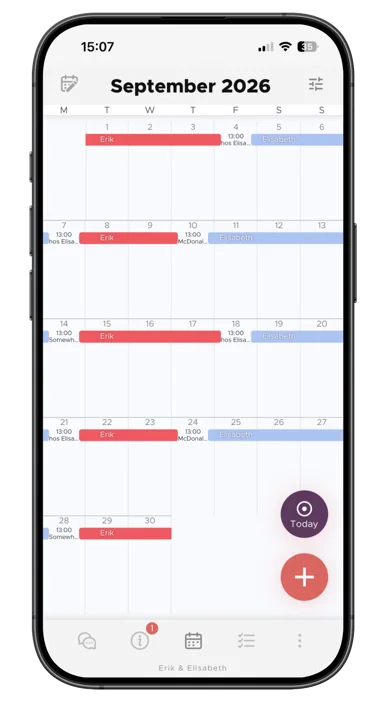
"The turning point came when we found the Every Other Week app. There's less fuss and both of us have a better handle on things. It feels so great!”
"Thank you so much for this app, it has finally gotten us to communicate!”

Housing & practical matters
Where should a child with two homes be registered? Learn how Skatteverket decides folkbokföring in shared custody and why the address matters for school.

Practical Matters
Practical tips for smoother transitions between two homes: packing together, warm welcome-home routines, and what to do if your child resists the move.

Housing & practical matters
Alternating weeks, 2+2+3+3 or living mainly with one parent: how to choose your child's living arrangements after a separation, and what matters most.