

Separation
Checklist: Separating With Children
Separating with children? A checklist of what to sort out first: where everyone lives, the schedule, handovers, money, sick days, and what to tell the kids.
Telling your children you're separating is a conversation many parents dread. But children often understand more than we think, and delaying the talk doesn't protect them — child psychologist Malin Bergström explains how to get it right.

It's difficult because parents are supposed to be their children's source of security and stability. During a separation, it's we adults who are unsettling their world. We are not stable, and we are breaking an essential contract with our children. We often delay the conversation because no parent wants to make their child sad.
Yes. In a crisis, our brain goes into survival mode, and finding the right words becomes hard. Our mental capacity narrows to the basics — survival, daily routines, simple solutions — while the brain works overtime to process the changes we're facing. The price is that our sharpness, creativity, and logic go on hold. We find it harder to be empathetic and to understand other people's needs. Until we've processed our own experience, it's challenging to make the situation understandable for our children. Even if we believe the divorce will lead to something better for us, it can be hard to feel that it benefits the children. Making them sad while trying to convey security and hope is difficult when the rug has just been pulled out from under our own lives.
Because once you tell them, the separation becomes real — and something everyone can talk about. What the children may have sensed finally gets an explanation. The truth can hurt, but it is often worse to sense that something is wrong and have to carry it alone. Once children know, they get the chance to share their questions and thoughts. Children are often very good at reading emotional atmospheres and interpreting non-verbal communication.
Most parents choose to tell their children about the separation together. It shows that you are both still present and can still talk to each other. You both know what was said and have seen the reactions, which helps later when questions and reactions need to be handled. A fruitful joint conversation requires you to set aside your differences and emotions. The conversation is a chance to show that, despite the separation, you will function as a parenting team that continues to care for your child. If you can build or maintain such a team, the consequences of the divorce will be less severe.
Understand that for children, this conversation is only the beginning of understanding — and eventually accepting — that the family will work in a new way. Children absorb emotionally charged information in stages, and questions and thoughts will keep coming over time.
It's good to have a plan for what to do once you've told them. It's common for children to withdraw and want to process what they've heard on their own. Follow their lead: show that you're there, but keep your distance if that's what they want. Don't force a conversation — show that you're ready to talk whenever they are. Stay close even if you can't directly comfort them; maybe sit outside the closed door. Make your presence known without pestering. And remember, it is never the child's job to comfort the adult.
Prepare for the situation where one of you moves out right away. Explain when the children will see that parent again and how they can stay in touch digitally in the meantime. Make sure you're reachable in the first days even if you're not at home with the children. Suggest relaxed activities or things you can help with.
Malin Bergström Child psychologist, associate professor and author
27 August 2026
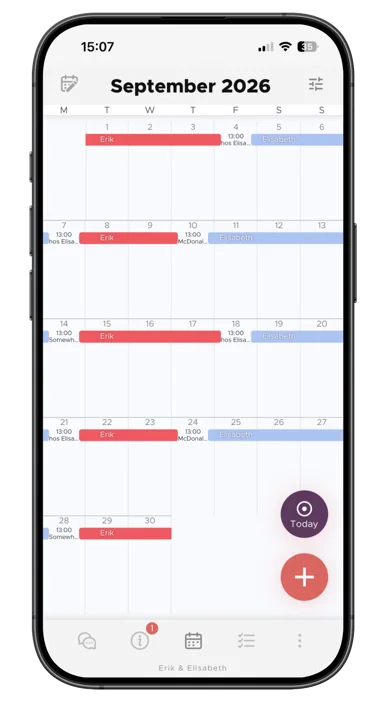
"The turning point came when we found the Every Other Week app. There's less fuss and both of us have a better handle on things. It feels so great!”
"Thank you so much for this app, it has finally gotten us to communicate!”

Separation
Separating with children? A checklist of what to sort out first: where everyone lives, the schedule, handovers, money, sick days, and what to tell the kids.

Separation
What to say when your child asks if you still love each other, or who wanted the divorce. Example answers to six tough questions, from a child psychologist.

Co-parenting
Separating and unsure who to tell? How to agree on a shared message, what to put in the email to your child's school, and what to say to family and friends.