





Cooperation
How Toxic Messages to Your Co-Parent Affect Your Child
Hostile texts and emails to your co-parent reach your child even if they never read them. Child psychologist Malin Bergström explains why — and what helps.
Children are quick to spot conflict — they may shout "stop arguing!" while we adults think we're just "discussing". Child psychologist Malin Bergström explains what actually counts as conflict between parents, and what constant conflict does to children.

When people hear the word "conflict", many picture verbal fights with raised voices and perhaps a swear word or two. That is one kind of conflict. Conflict between parents isn't a major source of worry for children — as long as the parents resolve it and make up. But children react instinctively to emotional signals, so they need adult support to manage the stress a conflict stirs up, and help interpreting their feelings and putting them into context. That's why it matters so much what our conflicts look like, and whether we adults manage to resolve them.
Conflict between parents doesn't have to mean open war. It can also look like:
Over time, patterns like these erode the trust between parents, leading to more conflict and full-blown arguments that never get resolved.
Parents can become so consumed by the conflict with their co-parent that they drag the children into it, actively or passively. For example:
Constant conflict between parents is hard on children. Arguments lock the energy into the parental relationship and leave children feeling alone. We are supposed to be the bedrock of their security — so when children start worrying about our well-being and safety, it hits them as hard as if they were threatened themselves. Children take responsibility for how things are between their parents and try, in different ways, to calm or avoid the conflicts. To cope, they sometimes develop strategies of their own.
It's a common misconception that open conflict harms children more than silent permafrost. In reality, children sense and adapt to moods whether the aggression is active or passive. And all children are affected by conflict, whatever their age. Babies and toddlers pick up the moods and emotions around them and are especially vulnerable because they depend so completely on us. Schoolchildren and teenagers suffer too, and can take on roles, responsibilities, and strategies that harm their well-being and development. Perhaps they become constantly vigilant to protect themselves from anger. Or they run away from home and end up in situations that aren't good for them. Encourage your children to talk to you about their feelings and worries, and reassure them that you are there to help.
Prolonged conflict between parents can also give children a bleak picture of what relationships and conflict resolution look like. Growing up around constant arguing increases children's own aggression. Their anger can be masked anxiety, or a way of carrying the pattern from home into other relationships. To avoid making the atmosphere at home even worse, a child may take their anger out at school or on friends instead of on the parents — which makes life harder still. Suddenly there may be no place, and no relationship, that feels safe from conflict. Naturally, this chips away at self-image and self-esteem. Conflict creates stress and anxiety, which undermine concentration and the child's own ability to handle stress — and then both friendships and schoolwork can suffer. A child who learns poor conflict management may also struggle later in life to stand up for themselves and to build secure, stable relationships with partners, friends, and other adults.
Protect your children from constant arguing between parents — whether that means loud fights or "permafrost conflicts" of persistent silence and a bad atmosphere. When conflicts do arise, children need to see and learn that conflict can be resolved and that everything is fine afterwards. Remind your children that even if an argument feels scary, things will work out in the end.
Parents can also protect their children by not letting situations of constant conflict go on — for example by seeking help from a couples counselor, or by separating.
Malin Bergström Child psychologist, associate professor and author
27 August 2026
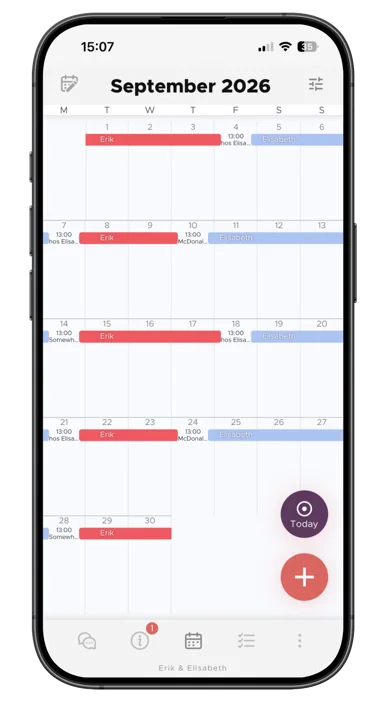
"The turning point came when we found the Co-parenting app. There's less fuss and both of us have a better handle on things. It feels so great!”
"Thank you so much for this app, it has finally gotten us to communicate!”

Cooperation
Hostile texts and emails to your co-parent reach your child even if they never read them. Child psychologist Malin Bergström explains why — and what helps.

England
Cooperation
A clear plan can reduce last-minute messages and misunderstandings. Here is what a parenting plan can cover in England, and how it differs from a court order.
United States
Cooperation
A written plan can reduce uncertainty about school weeks, holidays and handovers. In the United States, its legal effect depends on your state and whether the court has approved it.
Canada
Cooperation
A parenting plan puts the everyday arrangements in one place. For families in Canada, a useful plan explains both the weekly routine and how bigger decisions will be made.

Cooperation
Summer planning when you share custody: start early, agree on the holiday weeks, swap days when you need to, and balance old traditions with new ones.