





Cooperation
How Toxic Messages to Your Co-Parent Affect Your Child
Hostile texts and emails to your co-parent reach your child even if they never read them. Child psychologist Malin Bergström explains why — and what helps.
How we parents communicate during and after a separation plays a big role in our children's well-being. There is everything to gain from respecting each other's privacy and being generous with information about the children — but even with the best intentions, good communication can be hard.

If you find it hard to stay neutral with your co-parent, try treating them the way you would a colleague you struggle to get along with. Be "professional" — and avoid slipping into the role of either the boss or the assistant.
Neither of you has the right to be bossy — not if you feel wronged or guilty, and not even if you were the one who spent more time with the children during your relationship. Communication usually works best when you approach each other as equals. Discuss and reason together rather than giving orders or making demands; that tends to keep conflict to a minimum.
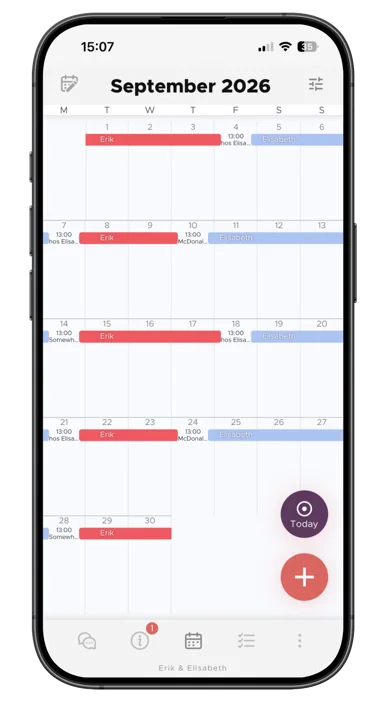
Did You Know? The Co-parenting app has no admin role, so both parents have equal space and influence in the app. That makes it easier to plan your own time, share information you would have written down for yourself anyway, and build trust between you and your co-parent.
Direct your energy toward what you can control: how the children are doing when they’re with you, and how you communicate with your co-parent. Instead of pushing advice or stepping in as the "voice of the child," ask whether you may offer a suggestion or share your thoughts. If your co-parent declines, respect that decision.
If communication between you and your co-parent is strained, it helps both you and the children to agree on what you’ll communicate about (the children, practical matters) and how you’ll do it.
Tip! Use the app’s tools to plan and share information — and run everything through the app if you need some extra space from each other right now. That leaves you more time and energy for other things, like the children. The Co-parenting app lets you decide together (or on your own) which topics are strictly about the children, and stick to those.
You may need more frequent communication if...
You might need less contact (and be more businesslike in your communication) if...
Depending on the children's ages, it’s wise to agree as a parenting team on how and when contact should happen while the children are with the other parent. The children’s needs come first, of course, but there are a few other factors to weigh in.
It’s sweet when a parent reaches out because they miss their child or want to show they’re thinking of them — but it can sometimes disturb the child’s adjustment, or keep them from “settling in” with the other parent. It’s usually better to let the children take the initiative.
If the children are school-aged and have their own phones, they can manage the contact themselves. Keep in mind that it’s not uncommon for children to “switch off” the parent they’re not currently with.
Children are often sensitive to their parents’ emotions. They may avoid contact if they sense that the parent they’re with gets upset or sad. In those cases, children can suppress their own needs to protect and comfort that parent.
Many parenting teams set a basic rule that the child initiates contact. You can also agree on set times for calling or video chats. Be considerate of what works for the parent the children are with at the time. Some parents agree that the parent with the children first checks with the other parent whether it’s a good moment for the children to call.
There’s no right or wrong here, as long as you can agree and both you and the children feel it’s working. But if the contact stirs up negative emotions and becomes distressing for the children, set up a clear structure for communication with the child — and stick to it.
Malin Bergström Child psychologist, associate professor and author
27 August 2026
"The turning point came when we found the Co-parenting app. There's less fuss and both of us have a better handle on things. It feels so great!”
"Thank you so much for this app, it has finally gotten us to communicate!”

Cooperation
Hostile texts and emails to your co-parent reach your child even if they never read them. Child psychologist Malin Bergström explains why — and what helps.

England
Cooperation
A clear plan can reduce last-minute messages and misunderstandings. Here is what a parenting plan can cover in England, and how it differs from a court order.
United States
Cooperation
A written plan can reduce uncertainty about school weeks, holidays and handovers. In the United States, its legal effect depends on your state and whether the court has approved it.
Canada
Cooperation
A parenting plan puts the everyday arrangements in one place. For families in Canada, a useful plan explains both the weekly routine and how bigger decisions will be made.

Cooperation
Summer planning when you share custody: start early, agree on the holiday weeks, swap days when you need to, and balance old traditions with new ones.