





Separation
Checklist: Separating With Children
Separating with children? A checklist of what to sort out first: where everyone lives, the schedule, handovers, money, sick days, and what to tell the kids.
Has your child been angrier or quicker to melt down since the separation? That's common. Child psychologist Malin Bergström explains where the anger comes from — and how small moments of full presence make a big difference.

Divorce often means children lose something important to them — contact with relatives, money, status, or a home they felt comfortable in. So it's not surprising that many children react with anger and irritability. Sometimes the anger flares because parents don't have their usual energy to distract, joke, and head off outbursts. Disrupted routines add to the frustration. Children can also turn angry and rejecting toward the parent they see as "guilty" of the divorce. Anger and sadness often go hand in hand — for many children, it's easier to get angry than to show that they're sad.
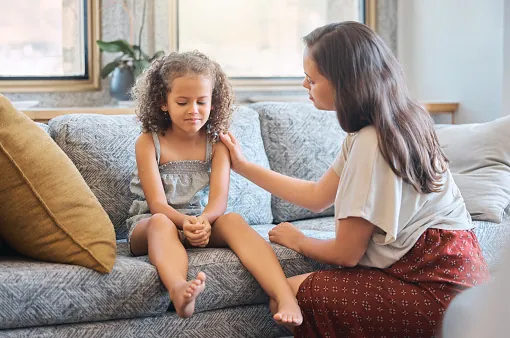
The anger can be a grief reaction that needs to come out. Talking to a child mid-outburst doesn't help; the child is blinded by emotion. It's better to focus on calming them down. After an outburst, children often become sad — and that's your chance to comfort them and hear what was hard. Try not to go on the defensive if you're accused. Instead, acknowledge that you understand the anger and that you're sorry the divorce (or your own behavior) has affected your child. But playing the victim, or giving up on setting boundaries for an angry child or teenager, doesn't help them.
As in other tricky parenting situations, the way forward is to affirm the feelings — "I hear that you're really angry and don't want to see me right now" — while still setting boundaries and doing what needs to be done: "but we're going to visit Grandma and Grandpa together anyway." That shows your child that you're in control of the situation, that you'll guide them through life, and that your relationship can withstand the anger. Ideally, the sadness eventually surfaces too, so the child can be comforted. In older children, teenagers, and young adults, anger can last a long time. The best way to repair the relationship is to keep seeking contact, endure the anger, and keep offering closeness and shared activities. It may take years before your child tells you they've come to understand more of what happened around the divorce.
Parents of angry children are often advised to plan moments in everyday life when they are truly present with their child — emotionally available and mentally there. As a separated parent, that advice is worth following whatever phase your child is in. If you're parenting alone, this kind of attention matters because daily life gets intense when you're responsible for everything. If you have a new partner, your child's relationship with that person is helped by you sometimes being there for your child alone — it can ease any jealousy. And if you share your child's time or see them less often, those moments help make up for the time you're apart.
The point is to make the interaction itself the focus, without expecting it to lead anywhere. That requires letting go of our thoughts about "later." Our willingness to throw ourselves into wild, playful time with our child is often held back by the memory of how hard it can be to calm an excited child down again. It's a natural parental instinct to stop the game before it starts, just to avoid chaos and conflict. With practice, the balance between winding up and winding down can become part of your parenting. Studies show this balancing act makes a difference — both in your relationship with your child and in the number of conflicts.
Malin Bergström Child psychologist, associate professor and author
27 August 2026
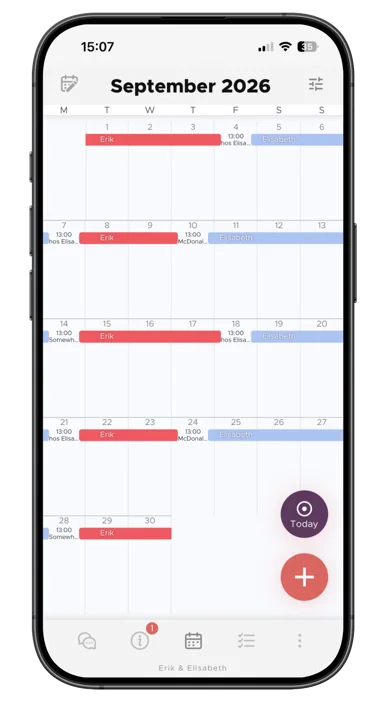
"The turning point came when we found the Co-parenting app. There's less fuss and both of us have a better handle on things. It feels so great!”
"Thank you so much for this app, it has finally gotten us to communicate!”

Separation
Separating with children? A checklist of what to sort out first: where everyone lives, the schedule, handovers, money, sick days, and what to tell the kids.
Separation
What to say when your child asks if you still love each other, or who wanted the divorce. Example answers to six tough questions, from a child psychologist.

Separation
Telling your children about a separation is hard. Child psychologist Malin Bergström on when to tell them, what to say and how to handle the days after.