





England
Cooperation
Making a Parenting Plan in England
A clear plan can reduce last-minute messages and misunderstandings. Here is what a parenting plan can cover in England, and how it differs from a court order.
An angry text takes seconds to send, but your child may carry it for a long time. Child psychologist Malin Bergström explains how hostile messages between parents reach children — even when they never read them — and how you can write to each other in a way that protects them.

Many of the conflicts I see between separated parents now play out on their phones. A text sent late at night, an email full of accusations, a string of short, sarcastic messages about a forgotten gym bag. It's easy to think it stays between the two of you. After all, your child can't see what you write.
But children have a remarkable radar for atmosphere. A common mistake is to believe that open fights hurt children more than a quiet, icy conflict. In fact, children pick up on the mood and adapt to it whether the hostility is out in the open or hidden. In an American diary study of 116 families, children were most distressed when their parents threatened or insulted each other, were hostile — or withdrew from each other. Calm discussion, support and affection made them feel more secure (Cummings et al., 2003). The researchers explain this with emotional security theory: children are constantly sensing whether their parents are a secure base, and conflict between them shakes that sense of security (Davies & Cummings, 1994).
The phone pings in the middle of dinner. Your pulse rises, you read the message again, you draft a reply in your head — and you no longer hear what your child is telling you about their day. Conflict between parents ties up energy your child needs. An American review of 39 studies found that conflict between parents goes hand in hand with harsher, less accepting parenting (Krishnakumar & Buehler, 2000). In other words, the conflict can reach your child through the way you parent, even if your child never sees the argument itself. That goes for both the parent who sends the message and the one who receives it.
Children read more than we think. Notifications pop up on the lock screen, the tablet shares an account with the phone, and school-age kids borrow your phone to play games. Older children and teenagers may read over your shoulder, or go looking. And written words last. Something said in the heat of the moment can fade, but a message saying Dad is useless or Mom is a bad parent can be read again and again. Your child loves you both and sees themselves in you both, so an attack on their other parent can feel like an attack on them.
When written contact becomes too toxic, many parents stop communicating with each other altogether. That's when a child easily becomes the messenger: "Tell your mom that …" Children in that role spend a lot of mental energy working out how to pass things on without making the conflict worse.
Being caught in the middle leaves its mark. In a classic American study, 522 adolescents were interviewed about four and a half years after their parents separated. Those who felt caught between their parents were doing worse, and that feeling was most common when parents had a lot of conflict and cooperated poorly. It was mainly through this feeling of being caught that the conflict was linked to how the adolescents were doing (Buchanan, Maccoby & Dornbusch, 1991).
What gets written in the chat follows you to daycare pickup: stiff faces, silence, a hello that never gets said. Your child can see that something is wrong but not what. Young children pick up on moods and are especially vulnerable because they depend on you so completely. School-age children may start taking responsibility for how the adults are doing — gritting their teeth, hiding their own needs and trying to cheer you up. Then they not only go without support themselves; they spend their energy supporting you.
The stress can show up at night, too. In an American study in which 8- and 9-year-olds wore a sleep monitor on their wrist for a week, children slept less and less well, and were sleepier, the more conflict there was between their parents (El-Sheikh et al., 2006).
Children learn how relationships work by watching what we adults do. Long-running conflict gives them a negative picture of relationships and of how conflicts get resolved, and children who grow up with a lot of fighting often become more aggressive themselves. The anger may come out at school or with friends, which makes life even harder for the child. The conflict also creates stress and worry that affect concentration, and both schoolwork and friendships can suffer.
A parent who is angry enough to send hostile messages often finds it hard not to let the contempt show in front of the children too — a sigh, a remark, a message read out loud. Perhaps you hope, consciously or not, that your child will see who is right. The research points the other way. American psychologists Jenna Rowen and Robert Emery asked nearly a thousand young adults how their parents had talked about each other. Those whose parents had denigrated each other felt less close to both parents — but above all to the parent who did it more often. The researchers describe it as a boomerang: denigration mainly hurts your own relationship with your child, not your child's relationship with the other parent (Rowen & Emery, 2018, 2019).
There's a hopeful side too. Professor Linda Nielsen of Wake Forest University has reviewed the research on parental conflict and parenting arrangements. She concludes that the quality of the parent–child relationship predicts how children fare better than conflict between the parents does — except for the most extreme forms of conflict (Nielsen, 2017). You can't control what your co-parent writes, but you have a great deal of power over how your child is doing with you — and over what you send.
In my Swedish book on separating with children, Att skiljas med barn, I describe contact within the co-parenting team with three guiding words: neutral, correct and friendly. That may sound like a joke when you're at your angriest, but a slightly businesslike tone lowers the risk of conflict and misunderstanding. Write to your co-parent the way you would write to a colleague you don't particularly like: politely, briefly and to the point.
Sometimes you're the one on the receiving end. It's hard, and it's tempting to respond in kind. But behavior is reinforced when it pays off. A parent who wants a fight may see anything that fuels the conflict as a win. If you stay neutral and don't feed the attacks, there's a better chance they will die out.
We're all human, and during a separation most of us say or write things we regret at some point. What matters is what you do next. If your child has read or heard something, acknowledge that it was wrong and that it isn't their responsibility. You might say: "I got so angry that I wrote some unkind things to Dad. That wasn't okay, and it isn't your fault. It's up to us grown-ups to sort this out."
Research suggests that repair matters. In American experiments, children reacted less negatively to adults' arguments when they learned that the conflict had been resolved — even when that happened behind closed doors, or when an adult explained afterward that it had been worked out (Cummings, Simpson & Wilson, 1993). You don't have to pretend you get along, but your child needs to hear that you adults are taking responsibility for the conflict.
Your relationship with your child is unique. No other relationship gives you as many chances to repair, apologize and start over.
In the Co-parenting app, every chat message passes through TalkSafe, our AI filter, before it is sent. Milder wording that could escalate a conflict is flagged to the sender with a suggestion for a calmer version. Anything worse is blocked outright and never reaches the recipient. In Settings, you can turn on a stricter filter that applies to everything sent both to and from you. Learn more in How the Stricter AI Filter Works.
A filter can't replace your own commitment to protecting your child. But it can give you that extra second to think before something is sent — and that second can make a big difference to your child.
Malin Bergström Child psychologist, associate professor, author and co-founder of Co-parenting
21 October 2026
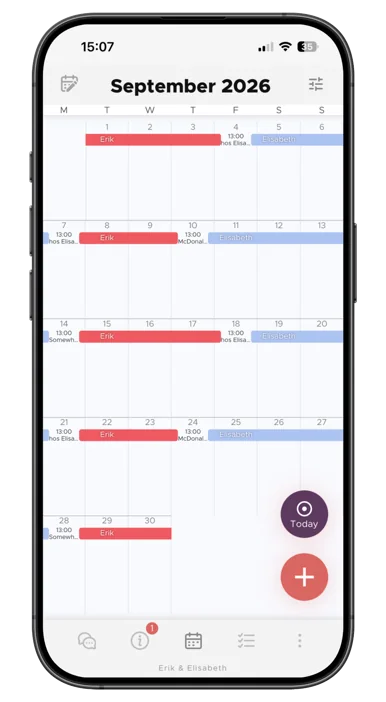
"The turning point came when we found the Co-parenting app. There's less fuss and both of us have a better handle on things. It feels so great!”
"Thank you so much for this app, it has finally gotten us to communicate!”

England
Cooperation
A clear plan can reduce last-minute messages and misunderstandings. Here is what a parenting plan can cover in England, and how it differs from a court order.
United States
Cooperation
A written plan can reduce uncertainty about school weeks, holidays and handovers. In the United States, its legal effect depends on your state and whether the court has approved it.
Canada
Cooperation
A parenting plan puts the everyday arrangements in one place. For families in Canada, a useful plan explains both the weekly routine and how bigger decisions will be made.

Cooperation
Summer planning when you share custody: start early, agree on the holiday weeks, swap days when you need to, and balance old traditions with new ones.

Cooperation
How to talk to your co-parent about the children without it turning into a fight: treat each other as colleagues, agree what you discuss and how often.