





Cooperation
How Toxic Messages to Your Co-Parent Affect Your Child
Hostile texts and emails to your co-parent reach your child even if they never read them. Child psychologist Malin Bergström explains why — and what helps.
Separation changes how you parent: areas that used to be "yours" or "theirs" now all land on you during your weeks with the children. It can feel overwhelming at first, but research shows it often leads to a deeper relationship with your child.

Living apart changes the conditions for parenting, both on your own and together. When you no longer share daily life with a partner, your parenting has to grow broader: you're the one doing braids, packing lunches, and teaching the kids to ride a bike. At the same time, you're building a shared, collective parenting with your co-parent. Don't worry — you can do this. You have what it takes to succeed as a parent, even living apart.
Children gain from having parents who bring different things to the table. An understanding, attentive parent offers security by supporting them through everyday worries, friendship troubles, or schoolwork. An active parent who loves to move introduces them to sports, outdoor life, and physical activity. A big extended family or a wide circle of family friends can brighten a child's life, especially if the other parent's lifestyle is quieter and less social.
The foundation of your parenting team is that you both love your child and want to be part of their life — and, just as importantly, that your child loves and needs both of you. Like any relationship, your co-parenting relationship will have highs and lows and will evolve over time.
Big-picture agreements — living arrangements, finances, and a structure for how you communicate — create stability and predictability for both you and your child.
A co-parenting team always puts the child's best interest first, and your contact should be neutral, correct, and friendly.
"Neutral" means your joint parenting is predictable and secure.
"Correct" means it rests on mutual respect, and that your child is spared emotionally draining scenes.
"Friendly" makes both you and your child happier with your family.
Maybe those words sound a little brisk. And of course, for many parents, contact doesn't look like this in the beginning. But keeping things more businesslike reduces the risk of conflict and misunderstanding. It also draws a clear line between co-parenting and a romantic relationship. A romantic relationship should be wild, alive, and playful — it springs from our emotional, spontaneous brain. A co-parenting relationship, on the other hand, needs structure. Neutral, correct, and friendly communication is mostly about practical information: checking in on how the children are doing, routines, and activities. It can also mean having coffee together or sitting side by side at the school Christmas show. And if you drift away from neutral, correct, and friendly, you can remind each other to focus on the children — knowing they are doing well is the strongest motivator there is.
Routines and clear channels of communication help you both stay emotionally balanced. When children experience a predictable, stable environment, they can put their energy into growing and developing instead of reacting to what's happening around them.
Keeping some emotional distance from each other also supports stability — partly because it helps you avoid triggers, and partly because closeness and friendship can stir up feelings that raise the risk of conflict. It would be wonderful if a friendship grows over time, but a romantic relationship usually needs a cooling-off period before it can turn into one. In the first phase after separation, it may be better to lean on others than on each other. That way you protect a future friendship from being swamped by conflict.
Later on you can afford to be freer and more spontaneous — and if conflict flares up, you can always return to a more structured approach.
Malin Bergström Child psychologist, associate professor and author
27 August 2026
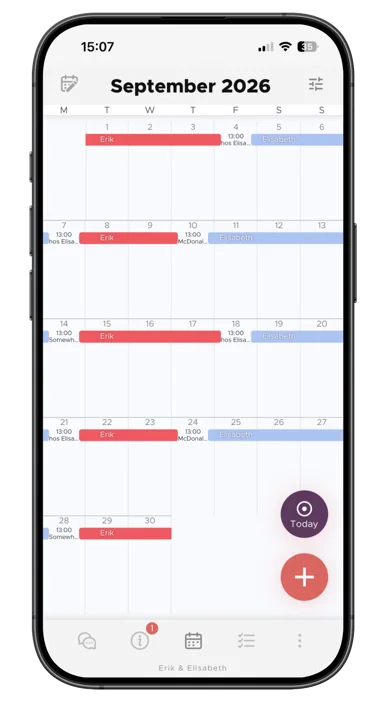
"The turning point came when we found the Co-parenting app. There's less fuss and both of us have a better handle on things. It feels so great!”
"Thank you so much for this app, it has finally gotten us to communicate!”

Cooperation
Hostile texts and emails to your co-parent reach your child even if they never read them. Child psychologist Malin Bergström explains why — and what helps.

England
Cooperation
A clear plan can reduce last-minute messages and misunderstandings. Here is what a parenting plan can cover in England, and how it differs from a court order.
United States
Cooperation
A written plan can reduce uncertainty about school weeks, holidays and handovers. In the United States, its legal effect depends on your state and whether the court has approved it.
Canada
Cooperation
A parenting plan puts the everyday arrangements in one place. For families in Canada, a useful plan explains both the weekly routine and how bigger decisions will be made.

Cooperation
Summer planning when you share custody: start early, agree on the holiday weeks, swap days when you need to, and balance old traditions with new ones.