



Creating Sustainable Agreements About Your Child

Good cooperation rests on stable agreements: everyone knows what happens, who does what, and when. Here's what to agree on about your child — and the pros and cons of different kinds of agreements.

A woman in glasses holds a pencil to her temple and looks down at her work, concentrating

Why an Agreement About Your Child Matters

Sustainable agreements bring peace of mind to children and parents alike, because everyone knows what to expect. After some time with a new agreement, things usually fall into place — perhaps with minor adjustments so it works for everyone. A steady routine pays off: it creates predictability and frees up energy for activities, friends, and everything else.

What Should You Agree On?

In general, it's good to agree on the following:

Custody

Will custody be joint, or will one parent have sole custody? In most cases custody is joint, which means the parents make the important decisions about the child together — things like the child's name, civil registration, non-routine medical care, passports, and choice of school. Both parents also have the right to information about the child from school, healthcare providers, and so on.

Where the Child Lives — and Visitation

Where, and with whom, will the child live? It might be alternating between two homes, if the parents live close to each other, cooperate well, and two-home life is workable for the child. Or it might be visitation: if the homes are far apart, or there are other reasons for the child to live mainly with one parent and see the other at set times, such as weekends and holidays. It's also wise to agree on when, where, and how handovers happen — and on who takes parental leave when, and so on.

Vacations and Major Holidays with Each Parent

Many children spend every other holiday with each parent. Some families fix certain breaks instead: one parent always gets the winter sports break, the other the spring break — and the summer vacation, being longer, is split evenly.

Practical Matters

  • How you will communicate: phone calls, the Co-parenting chat, or another channel.
  • What the child needs to bring between homes.
  • Shared routines across both homes: bedtimes, screen time, and more.
  • The child's special occasions: birthdays, school events, theater performances, games, Lucia processions, and the like. Do you both attend, or does one go to the Lucia procession while the other hosts the coffee afterward?

Different Kinds of Agreements

There are nearly as many ways to make agreements as there are children and parents, and what works for one family may not work for another. There are no formal requirements for what an agreement must look like or contain — but for it to be legally binding, certain criteria apply, as explained below.

The Common Mix: Written Base, Spoken Adjustments

Many parents who cooperate well mix oral and written agreements. Custody is usually already joint at separation, so the focus lands on residence and practical matters. Some parents write their agreements down; others settle on temporary arrangements a few months at a time.

The advantage of a written agreement as the base, with room for minor spoken adjustments, is that it's clear yet flexible. If the child needs more time with one parent for a while, that can be resolved smoothly in conversation.

The downside: with frequent changes, it gets hard to remember what was agreed, which invites chaos and misunderstandings — parents may remember events differently or have different needs.

How to Make an Agreement Legally Binding

When the relationship is conflict-ridden after the separation and cooperation is poor, a legally binding written agreement can be crucial. For some families, sticking strictly to a clear legal contract brings calm to the whole situation.

Parents who want to make their agreement legally binding can get help from familjerätten (the municipal Family Law Services) in the municipality where the child is registered. If both parents agree, the agreement is presumed to be in the child's best interests — but the social welfare committee must still make an objective assessment of whether it truly is.

There are no formal requirements for how the agreement is structured, but its content must be clearly worded to be enforceable in court. If the agreement covers several siblings, a separate agreement should be drawn up for each child.

Needs Change Over Time

When conflicts about the child are frequent, it can help to stick to a written — preferably legally binding — agreement for a period. If that brings more peace and better cooperation, you can gradually try spoken adjustments and see how they work.

In the end, it is the parents (as guardians) who decide what is best for their child given the circumstances. A good guiding principle: choose the option you believe gives your child the best conditions for stable, positive relationships with both parents — and peace and predictability over time.

Elisabeth Scholander Family law attorney and mediator, specialized in conflict resolution for families

27 August 2026

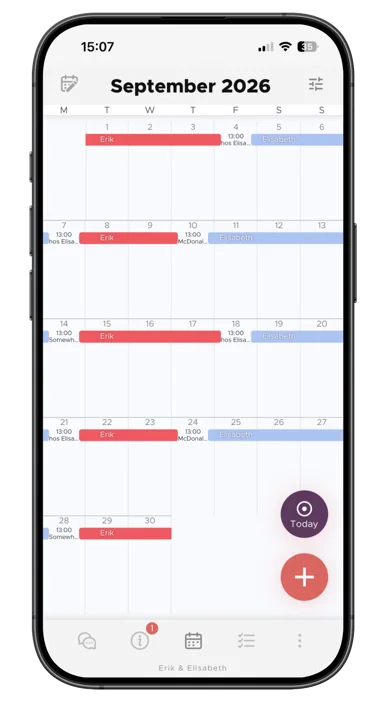
The app's calendar on a phone, showing each parent's weeks with the children as coloured bars

The app that frees up time for what's important

"The turning point came when we found the Every Other Week app. There's less fuss and both of us have a better handle on things. It feels so great!”

"Thank you so much for this app, it has finally gotten us to communicate!”

 

App ratings: 4.4 on the App Store and 4.7 on Google Play, four of five stars filled on each

Related reading

Cooperation

How Should We Communicate About the Children?

How to talk to your co-parent about the children without it turning into a fight: treat each other as colleagues, agree what you discuss and how often.

Read article

Co-parenting

How to Tell Others About Your Separation

Separating and unsure who to tell? How to agree on a shared message, what to put in the email to your child's school, and what to say to family and friends.

Read article