Who Decides on the Child's Living Arrangements?
In Sweden, joint custodians normally make important decisions about the child’s residence together. A sole custodian generally makes decisions about the child’s personal affairs, but the child’s best interests and existing contact arrangements still matter. A court can decide disputed residence or contact; the custody label alone does not describe the parenting schedule.
Alternate Living: Two Homes, Roughly Equal Time
Alternate living means the child has two homes and spends roughly equal time with both parents. Research on children's health and well-being after separation shows that regular contact with both parents benefits many children. Studies indicate that children from around age three generally do well in alternate living (reliable studies for younger children are lacking).
That said, alternate living doesn't suit every child and family, and different arrangements may work better during different periods. The common model of alternating weeks suits many children (and parents): the time split is even, feels fair, and is easy to keep track of. But the schedule can be shaped freely — plan according to what works best for your family.
Different Time Splits in Alternate Living
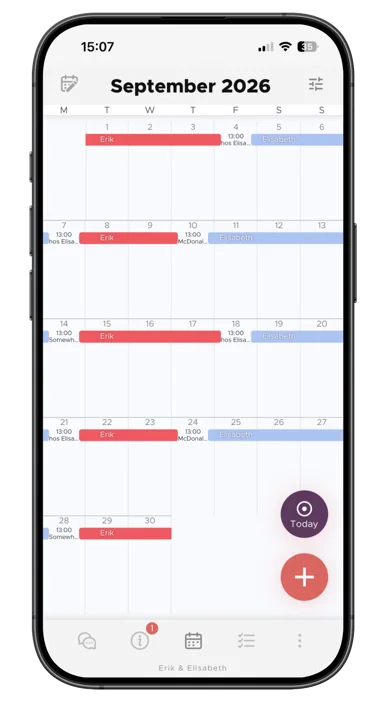
Alternate living can follow different rhythms: 7+7 days (alternating weeks) or shorter intervals such as 2+2+3+3 days. Children who struggle with transitions may do better with longer stretches, while more frequent changes can suit children who miss the parent they're away from. Young children might switch homes several times a week, school-age children once a week, and teenagers may prefer two-week stretches.
Live Close to Each Other if Possible
Finding homes near each other can be hard after a separation, and some parents unintentionally overlook their child's needs by moving far apart. Adults may want physical distance — but for the child it can be tough. Long distances mean tiring travel, and sometimes force the child to live with just one parent, which is hard on children who want to be with both.
Try to find homes in the same neighborhood, on the same bus route, or at least in the same community. That way your child can move easily between homes and keep their routines — and life gets simpler for you, too, when the child can get around safely without constant rides.
Booster Days to Ease the Longing
For children living in two homes, a mid-week visit — a "booster" day with the other parent — can ease the longing. Fixed days also make it easier for parents to plan activities and responsibilities.
Alternate living doesn't have to mean an exactly equal number of overnights. Adjusting the schedule around school, activities, and work can benefit everyone. If the child needs to live mostly in one home, extended weekends or a few evenings a week with the other parent can be a good alternative. And if sleeping in both homes is difficult, parents can still share the everyday: picking up from school, helping with homework, going to activities, or eating meals together.
When the Child Lives With One Parent and Visits the Other
Sometimes a child needs one main home with contact with the other parent, particularly when frequent transitions or long journeys are difficult. The Swedish Parental Code does not set a universal one-third-of-the-time boundary between contact and alternating residence.
For the parent who has full-time responsibility for the child, life often mirrors how things worked before the separation. The advantages are predictability and fewer compromises — and no longing for the child. The challenges are managing your energy, keeping a social life, and making sure the child still gets meaningful time with the other parent. If the child misses the other parent, it's essential to encourage and support that relationship.
The Financial Impact
In Sweden, the child’s maintenance is assessed from the child’s needs and the parents’ financial capacity. Living mainly with one parent can make a maintenance payment relevant, but it is not an automatic payment of a fixed amount to that parent. Maintenance can also be relevant in some alternating-residence cases. Paid work, childcare and care-related income loss affect the household budget separately.
Daycare, school, activities and support from family or friends can make everyday life more manageable. In Sweden, a person other than a parent can sometimes receive temporary parental benefit for caring for a child, including through an eligible transfer. Being a relative or helping with care is not sufficient on its own; Försäkringskassan’s conditions must be met.
To the Parent the Child Visits
Think about how to keep contributing what's yours to give: shared interests, relatives, family friends. Fit as much quality time as you can into the schedule you have. Helping out the parent the child lives with benefits your child as well.
If there are no major conflicts, it's good for both parents to stay involved. Share information, attend parent-teacher conferences (in person or online), and take part in your child's activities.
Give Both Parents Weekdays and Weekends
Whatever the living arrangement, try to make sure your child spends both weekdays and weekend time with each parent. Handling every daily routine alone is tough — but only seeing your child on weekends means missing everyday life. Talking with teachers and coaches is part of parenting, and a weekend-only parent easily misses out on it. Balancing the time helps both parents stay connected to every part of the child's life.
Flexibility Is Key
Living and visitation schedules may need to be discussed, tested, and adjusted several times. Even with an equal-time agreement, flexibility is crucial. Your child is a full member of the family, and their needs and wishes must be weighed alongside your jobs, commitments, and practicalities. Meeting your child's needs doesn't necessarily mean more time with the parent the child currently prefers. The other parent can still build the bond through after-school activities or half-day weekend visits. Strong relationships with both parents even out the imbalance over time.
Summary
- The primary consideration is the child's needs, not fairness between the parents.
- Many children thrive in some form of alternate living, spending substantial time with both parents.
- For others, the transitions are too stressful, and parents must adjust the plan for the child's sake — even if it means one parent sees the child less.
- Time with the child doesn't always mean equal overnights. It can be more weekend time, joining activities, and similar arrangements.