




Practical Matters
Custody Exchanges: Rules for Calmer Handovers
Where and when to do custody exchanges, who drives, what travels with the child, what to do when a parent is late, and a sample exchange clause.
A parenting plan is the written version of how two homes will work: where the children sleep, who decides what, how you talk to each other, and what happens when plans change. Here is what a thorough one covers, section by section.
The short version
Use these as questions to answer together. Not every family needs every section, and a plan that covers fewer things clearly is better than one that covers everything vaguely.
Custody schedule examples compares alternating weeks, 2-2-3, 2-2-5-5, 3-4-4-3 and every other weekend, with the overnights each gives.
The holiday custody schedule guide goes through each, with an even/odd-year example.
In the United States this is usually called legal custody. Read parental responsibility and custody in the US.
Read how to communicate with your co-parent, and what to do when a co-parent badmouths you to the children.
See child support in the United States and keeping track of your child's costs in two homes.
Whether a parent who cannot look after the children during their own time offers that time to the other parent first. See right of first refusal.
Read moving with your child in the United States.
See who can help with parenting disputes in the US.
What suits a toddler rarely suits a teenager. Agree when you will revisit the plan, and how older children's views will be heard. Read parenting a teenager after a separation.
Specific enough that two people who disagree would read it the same way. The figures below are examples, not recommendations.
| Vague | Specific |
|---|---|
| Alternate holidays | Thanksgiving with parent A in even-numbered years and parent B in odd-numbered years, from Wednesday at 6 p.m. to Sunday at 6 p.m. |
| Share the summer | Each parent may take up to two consecutive weeks of vacation in the summer, chosen in writing by April 1. Parent A chooses first in even-numbered years. |
| Split extra costs | Activity, school and uncovered medical costs over $50 are agreed in writing in advance, split 60/40, and repaid within 30 days of the receipt. |
| Keep each other informed | Messages about the children go through one app and are answered within 48 hours. Emergencies are a phone call. |
Parents write plans on their own, with a mediator, or through lawyers. Many courts publish a parenting plan form, and starting from it means the court sees what it expects. Whichever route you take, it is worth having a family lawyer read the plan before you sign or file it, especially if there is a court case or a lot of conflict.
If there is violence or intimidation in the relationship, joint negotiation or mediation may not be safe. Talk to a lawyer or a domestic violence service first.
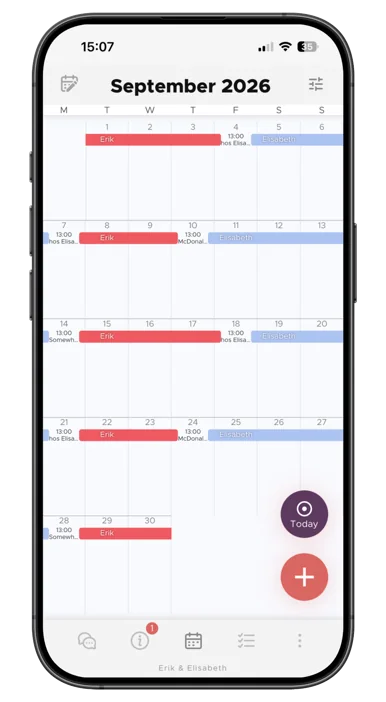
A plan works only if the calendar matches it. In the Co-parenting app the schedule is a proposal until the other parent accepts it, and once it is active, every change is a request the other parent has to accept, so the calendar always shows what you both agreed. Chat logs and change requests can be exported as a verifiable PDF, a file that carries proof it has not been edited afterwards. See the FAQ.
A written agreement between separated parents about how they will raise their children in two homes: the schedule, holidays, decision-making, communication, expenses and how changes are made.
A plan the court approves usually becomes part of the custody order, and the court can enforce it. A plan you only agree between yourselves is still a useful agreement, but it may be harder to enforce. How this works depends on your state or country.
Not always. Many parents write their own, often starting from their court's form, or with a mediator. Having a family lawyer review it before you sign or file it is a good idea, and important if there is conflict or a safety concern.
The plan is the detailed arrangement. The order is the court's decision. An approved plan is often included in or attached to the order.
Yes. Parents can agree changes, and a plan can say how changes are requested and reviewed. If the plan is part of a court order, changing the order itself usually needs the court; ask a family lawyer where you live.
Which holidays are split and how — alternating years, a split day or the same parent every year — with exact start and end times, plus winter break, spring break and summer, and what happens to the regular schedule afterwards.
6 November 2026
"The turning point came when we found the Co-parenting app. There's less fuss and both of us have a better handle on things. It feels so great!”
"Thank you so much for this app, it has finally gotten us to communicate!”

Practical Matters
Where and when to do custody exchanges, who drives, what travels with the child, what to do when a parent is late, and a sample exchange clause.
Cooperation
What a right of first refusal clause means in a parenting plan, how the time threshold and notice work, who counts as childcare, and when to leave it out.

Cooperation
Hostile texts and emails to your co-parent reach your child even if they never read them. Child psychologist Malin Bergström explains why — and what helps.