




Housing & practical matters
Birthdays, Mother's Day and Father's Day
How to handle the children's birthdays, the parents' birthdays, Mother's Day and Father's Day in two homes, with the dates for 2026 to 2030.
Christmas is the holiday parents most often split rather than alternate, because few want to miss it every other year. Here are the common ways to divide Christmas Eve, Christmas Day and the rest of winter break, with the days of the week through 2030.
The short version
In the most common split, one parent has the children from Christmas Eve afternoon until noon on Christmas Day, and the other from noon on Christmas Day until a set time — often the next day. The next year they swap. Both parents get part of the holiday every year, and the children wake up on Christmas morning in alternating homes.
| Year | December 24 | December 25 | Christmas Eve and morning with | Christmas Day from noon with |
|---|---|---|---|---|
| 2026 | Thursday | Friday | Parent A | Parent B |
| 2027 | Friday | Saturday | Parent B | Parent A |
| 2028 | Sunday | Monday | Parent A | Parent B |
| 2029 | Monday | Tuesday | Parent B | Parent A |
| 2030 | Tuesday | Wednesday | Parent A | Parent B |
A variation moves the exchange to Christmas Eve evening, so one parent has the day of the 24th and the other has Christmas Eve night and Christmas morning.
From December 24 to 26 with one parent, alternating by year. It suits parents who live far apart or travel to family, at the cost of a Christmas without the children every other year.
If one family's main celebration is on Christmas Eve — as in many Scandinavian, Polish and Latin American traditions — and the other's is on Christmas Day, keeping the split fixed gives each household the day that matters to it.
Some families celebrate again on December 26 or 27 at the second home. Children rarely object.
Winter break usually runs from the day school lets out until the day before it restarts, and its length differs by district. A common approach is to split it in halves, with the parent who has the first half one year taking the second half the next.
Take a district whose last day before the break is Friday, December 18, 2026 and which reopens on Monday, January 4, 2027. That is 17 nights of break. Switching on December 26 at noon gives the first half 8 nights (December 18 to 25) and the second half 9 (December 26 to January 3). Splitting an odd number of nights is never exactly even, which is one more reason to alternate the halves by year.
If you also split Christmas Eve and Christmas Day, write down which rule wins. Usually it is the Christmas split, with the halves covering the rest of the break.
They often go with whichever half of the break they fall in. Some families alternate them separately, and teenagers may have plans of their own — worth asking about rather than assuming.
In the United Kingdom and Canada, Boxing Day on December 26 is a public holiday too, and is often part of the split.
Public holidays are filled in for where you live, and you can import your child's actual school holidays — the dates the school has published — for almost every school across North America, the EU and Australia. See how to import a school calendar, then check the dates it finds against the school's own information.
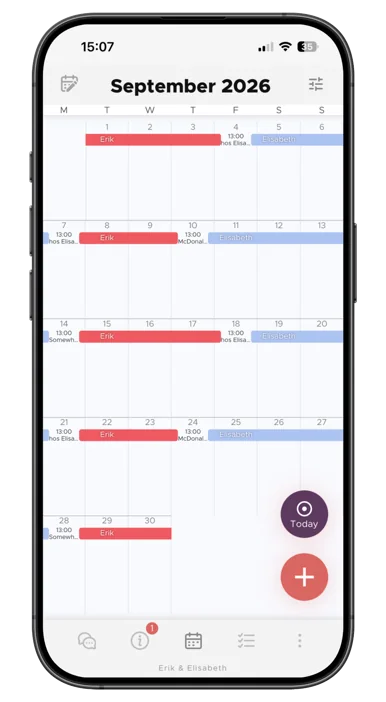
The Christmas arrangement goes into the schedule as a proposal: change the days directly, or apply a template between two dates — a different rotation for the summer, for example. Nothing changes until the other parent accepts it, and once the schedule is active, every change is a request the other parent has to accept. The FAQ has more on schedules and change requests.
It depends on the plan. The most common arrangement is Christmas Eve and Christmas morning with one parent, then Christmas Day from about noon with the other, swapping each year.
In halves, from the day school lets out to the day before it restarts, with the parents alternating which half they have each year. Christmas itself is often handled separately.
In most plans, yes. School breaks override the regular rotation, and specific holidays such as Christmas override the break schedule.
Midday or early afternoon is common, so that each home has a meal and the children are not traveling late. Choose a time and write it down.
Agree on the big gifts in advance and keep one shared list of ideas, marking what has been bought.
6 November 2026
"The turning point came when we found the Co-parenting app. There's less fuss and both of us have a better handle on things. It feels so great!”
"Thank you so much for this app, it has finally gotten us to communicate!”
Housing & practical matters
How to handle the children's birthdays, the parents' birthdays, Mother's Day and Father's Day in two homes, with the dates for 2026 to 2030.
Housing & practical matters
How to split holidays between two homes: alternating years, split days, fixed holidays and divided breaks, with an even/odd-year example for 2026 to 2030.
Housing & practical matters
How to split spring break and summer between two homes: alternating years, summer rotations, vacation weeks and notice deadlines, with the nights each adds.