




Housing & practical matters
Birthdays, Mother's Day and Father's Day
How to handle the children's birthdays, the parents' birthdays, Mother's Day and Father's Day in two homes, with the dates for 2026 to 2030.
Holidays are where a regular custody schedule stops working on its own. Here are the four common ways to split them, an even/odd-year example with the real dates for 2026 to 2030, and what to write down so nobody renegotiates each one.
The short version
A holiday schedule is a set of exceptions to the regular rotation. Most plans rank them: specific holidays such as Thanksgiving or a birthday come first, then school breaks, then the regular rotation. When two rules collide — Mother's Day falls in the other parent's weekend — the higher one wins.
Decide, too, what happens when the holiday is over. A common choice is that the regular rotation carries on underneath, as if it had never paused, so the next exchange is the one the rotation would have had anyway. Restarting the rotation after each holiday shifts every week that follows, which tends to cause more confusion than it solves.
One parent has the holiday in even-numbered years and the other in odd-numbered years. It is simple and fair over two years. The cost is that each parent misses the holiday every other year.
Both parents get part of it — the morning with one, the afternoon and evening with the other — swapping each year. It works best when the homes are close, and it can mean a lot of driving on a day meant to be relaxed.
Some days belong to one parent: Mother's Day and Father's Day, a parent's own birthday, a holiday only one household celebrates. Many plans give these to the same parent every year.
Longer breaks — winter break, spring break, summer — are often split in halves or blocks, alternating which part each parent gets.
Most plans mix them: alternate the big holidays, split Christmas, fix Mother's Day and Father's Day, and halve the breaks.
Here is one way to divide common US holidays into two groups that alternate by year. It is an example, not a recommendation: move holidays between the groups until it reflects what matters to your family. The dates are calculated for each year.
| Holiday | 2026 | 2027 | 2028 | 2029 | 2030 |
|---|---|---|---|---|---|
| Martin Luther King Jr. Day weekend (group 1) | Jan 19: A | Jan 18: B | Jan 17: A | Jan 15: B | Jan 21: A |
| Presidents' Day weekend (group 2) | Feb 16: B | Feb 15: A | Feb 21: B | Feb 19: A | Feb 18: B |
| Easter (group 1) | Apr 5: A | Mar 28: B | Apr 16: A | Apr 1: B | Apr 21: A |
| Memorial Day weekend (group 2) | May 25: B | May 31: A | May 29: B | May 28: A | May 27: B |
| Independence Day (group 1) | Jul 4: A | Jul 4: B | Jul 4: A | Jul 4: B | Jul 4: A |
| Labor Day weekend (group 2) | Sep 7: B | Sep 6: A | Sep 4: B | Sep 3: A | Sep 2: B |
| Halloween (group 2) | Oct 31: B | Oct 31: A | Oct 31: B | Oct 31: A | Oct 31: B |
| Thanksgiving (group 1) | Nov 26: A | Nov 25: B | Nov 23: A | Nov 22: B | Nov 28: A |
| Christmas Eve and Christmas morning | Dec 24: A | Dec 24: B | Dec 24: A | Dec 24: B | Dec 24: A |
| Christmas Day from noon | Dec 25: B | Dec 25: A | Dec 25: B | Dec 25: A | Dec 25: B |
| Mother's Day (same parent every year) | May 10: mother | May 9: mother | May 14: mother | May 13: mother | May 12: mother |
| Father's Day (same parent every year) | Jun 21: father | Jun 20: father | Jun 18: father | Jun 17: father | Jun 16: father |
A and B are the two parents. Parent A has group 1 in even-numbered years and group 2 in odd-numbered years; parent B has the reverse. Christmas is split rather than alternated, swapping each year, and Mother's Day and Father's Day stay with the same parent every year. Monday holiday weekends usually run from Friday after school to Monday evening, or to Tuesday morning at school — say which.
Break dates differ by district, and sometimes between siblings at different schools. Define a break by the day school lets out and the day it restarts rather than by calendar dates, so the rule still works next year.
Religious and cultural holidays — Hanukkah, Diwali, Eid al-Fitr, Lunar New Year, Rosh Hashanah and many others — follow calendars that move against the usual one. Name the holiday and the rule ("the first evening of Hanukkah with parent B every year") rather than a date, and check the dates together each fall. Where you celebrate different holidays, giving each parent their own every year is often the simplest answer.
Public holidays are filled in for where you live, and you can import your child's actual school holidays — the dates the school has published — for almost every school across North America, the EU and Australia. See how to import a school calendar, then check the dates it finds against the school's own information.
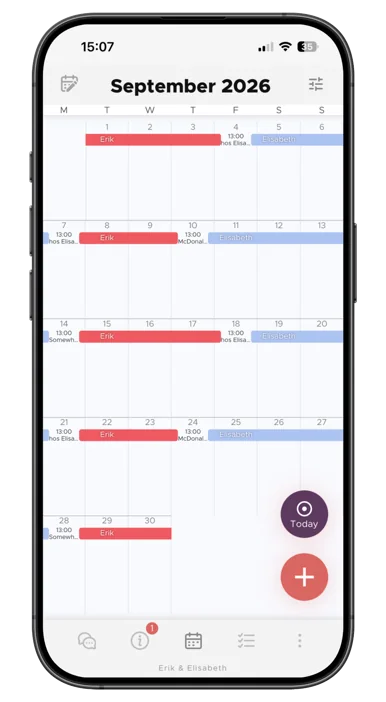
The holiday arrangement goes into the schedule as a proposal: change the days directly, or apply a template between two dates — a different rotation for the summer, for example. Nothing changes until the other parent accepts it, and once the schedule is active, every change is a request the other parent has to accept. The FAQ has more on schedules and change requests.
In most parenting plans, yes: specific holidays come first, then school breaks, then the regular rotation. The plan should say so, and say what happens to the rotation afterwards.
One parent has a holiday in even-numbered years and the other in odd-numbered years. For example, Thanksgiving Nov 26, 2026 with parent A, and Nov 25, 2027 with parent B.
It depends on the plan. Common arrangements are splitting Christmas Eve and Christmas Day with an exchange around midday on the 25th, swapping each year, or alternating the whole holiday by year.
A common choice is that the regular rotation carries on as if it had never paused, so the next exchange is the one the rotation would have had anyway. Write down whichever you choose.
Many plans give a holiday that only one household celebrates to that parent every year. For holidays whose dates move, name the holiday and the rule rather than a date.
Usually the holiday wins. That is why it helps to rank the rules in the plan: specific holidays, then school breaks, then the regular rotation.
6 November 2026
"The turning point came when we found the Co-parenting app. There's less fuss and both of us have a better handle on things. It feels so great!”
"Thank you so much for this app, it has finally gotten us to communicate!”

Housing & practical matters
How to handle the children's birthdays, the parents' birthdays, Mother's Day and Father's Day in two homes, with the dates for 2026 to 2030.
Housing & practical matters
How to split Christmas Eve, Christmas Day and winter break between two homes, with the days of the week for 2026 to 2030 and a worked example.
Housing & practical matters
How to split spring break and summer between two homes: alternating years, summer rotations, vacation weeks and notice deadlines, with the nights each adds.