




Housing & practical matters
2-2-3 Custody Schedule: How It Works
The 2-2-3 custody schedule explained with a two-week calendar: overnights per year, exchanges, pros and cons, and which ages it tends to suit.
A custody schedule is a rotation that says which parent the child sleeps with each night. Here are the main ones side by side — how the nights split, how often the child changes homes, and how long the longest stretch away from a parent is.
The short version
Every row below is a two-week rotation, and every number is counted from that rotation, so you can check it against the grid on each schedule's own page. Parent A and parent B are placeholders; swap them to suit.
| Schedule | Nights per 14 days (A / B) | Exchanges per 14 days | Longest stretch with one parent | Nights per year (A / B) |
|---|---|---|---|---|
| Alternating weeks (7-7) | 7 / 7 | 2 | 7 nights | 182.5 each |
| 2-2-3 | 7 / 7 | 6 | 3 nights | 182.5 each |
| 2-2-5-5 (also 5-2-2-5 or 2-5-5-2) | 7 / 7 | 4 | 5 nights | 182.5 each |
| 3-4-4-3 (also 4-3-3-4) | 7 / 7 | 4 | 4 nights | 182.5 each |
| Every other weekend (Friday and Saturday nights) | 12 / 2 | 2 | 12 nights with the main home; 2 with the weekend parent | 313 / 52 |
| Every other weekend plus a weekly midweek overnight | 10 / 4 | 6 | 6 nights with the main home; 2 with the other parent | 261 / 104 |
A year has 365 nights, so an exact 50/50 split is 182.5 each. In practice one parent has 182 and the other 183, or the odd night is swapped at a holiday.
There is no best schedule, only the one that fits a particular child and two particular households. These are the questions that usually decide it:
For a longer look at the options, including how families think about it, read child living arrangements after separation and what researchers say about living in two homes.
Parenting time is usually counted in nights, not days. Take the nights one parent has in a full rotation, divide by the length of the rotation, and multiply by 365 for the year. Two nights out of every 14 is 14.3%, about 52 nights a year; five out of 14 is 35.7%, about 130.
The count matters because some courts and child support formulas treat a minimum number of overnights as a threshold. The numbers, and what they change, differ from state to state and country to country, so check the rules where you live with a family lawyer or your court's self-help center before you choose a schedule for the arithmetic alone. Holidays and school breaks usually override the regular rotation, so the real yearly figure drifts a little from the textbook one.
The rotation covers ordinary weeks. A workable arrangement also says what happens on holidays, birthdays and school breaks, who handles transport, how a change is asked for and answered, and how the costs are shared. Writing those down once, in the same place as the calendar, is what stops the schedule from being renegotiated every month.
The app has templates for the common arrangements — alternating weeks, 2-2-3, 2-2-5-5, every other weekend and the rest — and you can build a custom schedule if yours does not look like any of them. Because a schedule is only a proposal until the other parent accepts it, you can put one together, see how it falls across the year, and change it before either of you has agreed to anything. After that, every change is a request the other parent has to accept. Read how the shared calendar works or the FAQ.
Alternating weeks, 2-2-3, 2-2-5-5 and 3-4-4-3 all give each parent 7 of every 14 nights, so all four are an even split over a full cycle. They differ in how often the child changes homes (2 to 6 times every two weeks) and how long the child can go without seeing a parent.
A year has 365 nights, so an exact 50/50 split is 182.5 nights each: 182 for one parent and 183 for the other. In a two-week rotation it is 7 nights each.
Alternating weeks has the fewest of the 50/50 schedules, with 2 exchanges every two weeks. Every other weekend also has 2, but it is not an even split.
There is no single best schedule for young children. Many families choose shorter blocks and more frequent contact for babies and toddlers, and move toward longer blocks as the child grows, but it depends on the child and on both parents' availability. Our article on shared parenting for babies and toddlers goes through it.
No. A plain every-other-weekend schedule with Friday and Saturday nights gives the weekend parent 2 of 14 nights, about 14.3%. Adding a weekly midweek overnight takes it to about 28.6%.
In the Co-parenting app, yes: a schedule is only a proposal until the other parent accepts it, so you can build one and see how it falls across the year first. Outside the app, many families agree to a trial period of a few weeks and write down when they will review it.
2 November 2026
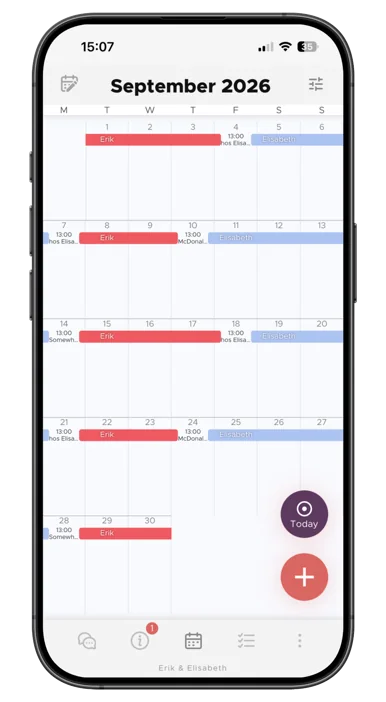
"The turning point came when we found the Co-parenting app. There's less fuss and both of us have a better handle on things. It feels so great!”
"Thank you so much for this app, it has finally gotten us to communicate!”

Housing & practical matters
The 2-2-3 custody schedule explained with a two-week calendar: overnights per year, exchanges, pros and cons, and which ages it tends to suit.
Housing & practical matters
The 2-2-5-5 custody schedule, also called 5-2-2-5 or 2-5-5-2: a two-week calendar, overnights per year, exchanges, pros and cons, and who it suits.
Housing & practical matters
How the 3-4-4-3 custody schedule works, also called 4-3-3-4: a two-week calendar, why the start day decides who gets the weekends, pros and cons.