




Cooperation
What to Include in a Parenting Plan
A parenting plan checklist: the regular schedule, holidays, exchanges, decisions, communication, expenses, travel and how to change the plan later.
Every rotation comes down to the moment the child moves from one home to the other. Here is how to set the place, the time and the rules so that handovers are short, predictable, and not a stage for the adults' disagreements.
The short version
| Place | How it works | Good for |
|---|---|---|
| School or daycare | One parent drops off in the morning, the other picks up after school. | Tense relationships: the parents do not have to meet |
| The curb outside one home | The child walks out to the car; the other parent does not come in. | Most families, when things are calm |
| A neutral public place | A parking lot, library or café, often halfway. | Long distances, or when neither home works |
| A supervised exchange center | Staff oversee the handover. | Safety concerns, or a court order requiring supervision |
In the Co-parenting app, the packing list is generated fresh for each handover. You or your child tick off each item as it is packed, and your co-parent gets a notification that it is ready. Read kids' belongings in two homes.
Transitions are hard for many children, whatever the adults do. Read how to ease transitions between two homes, and, if a child does not want to go, when kids favor one parent.
If you are afraid at handovers, or there is a protective order, do not meet in person. Use school, a supervised exchange center, or ask your court about the options. In an emergency, call the emergency number: 911 in the United States and Canada, 999 in the UK.
Exchanges take place at the children's school on school days, and otherwise at the curb outside the receiving parent's home at 6 p.m. The parent whose time is starting picks the children up. A parent running late will message the other as soon as they know; after 30 minutes without word, the waiting parent may leave, and the parents will agree a new time in writing. Neither parent will discuss disputes during exchanges or send messages through the children.
This is example wording only. Have a family lawyer check any clause before it goes into a plan or an order.
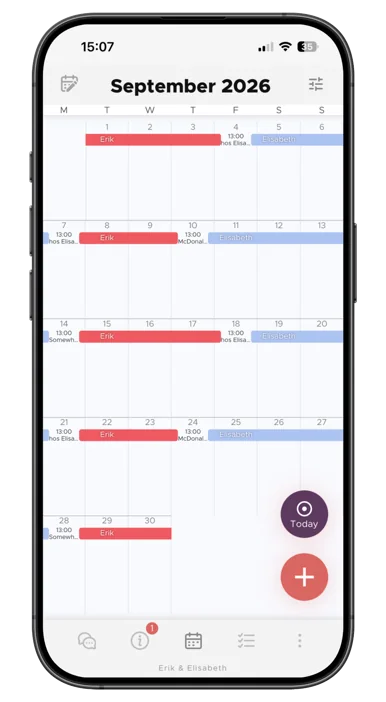
Each handover in the calendar can carry its own time and place, set as part of a schedule proposal the other parent accepts. The packing list follows every handover, and messages show when they have been read, so "I'm running late" is seen rather than guessed at. You can also log a GPS check-in when you arrive, so there is a record of where you were and when. See the FAQ.
The rest of the plan is covered in what to include in a parenting plan.
Where the parents do not have to meet is often best: drop-off and pick-up at school or daycare. Otherwise the curb outside one home, a neutral public place, or a supervised exchange center if there are safety concerns.
Whoever the plan says. A common rule is that the parent whose time is starting picks the children up; meeting halfway suits long distances.
As long as the plan says. Plans often set a grace period of 15 to 30 minutes and say what happens after it.
Keep a dated note of each one, raise it in writing, and try mediation. If there is a court order and it keeps happening, talk to a family lawyer.
Listen to why, without blaming the other parent, and talk to them about it. If it continues, get advice from a family counselor, and if there is a court order, ask a family lawyer what it requires of you.
6 November 2026
"The turning point came when we found the Co-parenting app. There's less fuss and both of us have a better handle on things. It feels so great!”
"Thank you so much for this app, it has finally gotten us to communicate!”

Cooperation
A parenting plan checklist: the regular schedule, holidays, exchanges, decisions, communication, expenses, travel and how to change the plan later.
Cooperation
What a right of first refusal clause means in a parenting plan, how the time threshold and notice work, who counts as childcare, and when to leave it out.

England
Cooperation
A clear plan can reduce last-minute messages and misunderstandings. Here is what a parenting plan can cover in England, and how it differs from a court order.
United States
Cooperation
A written plan can reduce uncertainty about school weeks, holidays and handovers. In the United States, its legal effect depends on your state and whether the court has approved it.
Canada
Cooperation
A parenting plan puts the everyday arrangements in one place. For families in Canada, a useful plan explains both the weekly routine and how bigger decisions will be made.