




Practical Matters
Custody Exchanges: Rules for Calmer Handovers
Where and when to do custody exchanges, who drives, what travels with the child, what to do when a parent is late, and a sample exchange clause.
A right of first refusal says that if one parent cannot look after the children during their own time, the other parent gets the first chance to, before anyone else. It can mean more time with both parents. Worded loosely, it can also mean constant contact and new arguments.
The short version
For example: parent A has the children from Friday to Sunday and is called in to work from 2 p.m. to 10 p.m. on Saturday. The plan's threshold is four hours, so A offers the time to parent B before calling a babysitter.
If there has been domestic abuse, if there is a protective order, or if conflict is so high that every contact becomes an argument, a right of first refusal tends to create more friction than it is worth. The same goes when the homes are far apart. In those situations, read about parallel parenting, and get legal advice.
If either parent will be unable to care for the children for more than four consecutive hours during their parenting time, that parent will first offer the time to the other parent by message at least 24 hours in advance, or as soon as they know if it is less. The other parent will answer within two hours. Time with a step-parent, grandparent or other family member named in this plan does not trigger this clause. The parent accepting the time is responsible for transport. The regular schedule is not otherwise changed.
This is example wording only. Have a family lawyer check any clause before it goes into a plan or an order.
A right of first refusal depends on fast, clear messages. In the Co-parenting app, the offer and the answer sit in one thread with read receipts, so "I never saw it" stops being an argument, and messages cannot be edited or deleted afterwards. For longer changes, a schedule change request has to be accepted by the other parent before anything moves.
The rest of the plan is covered in what to include in a parenting plan, including custody exchange rules.
It is a clause in a parenting plan that says if one parent cannot care for the children during their own parenting time for longer than a set period, they must offer the time to the other parent before arranging other childcare.
Plans differ. Some use a number of hours, such as four; others apply it only to overnights. A threshold that is too short turns every errand into a negotiation.
Only if your plan says so. Many plans state that time with a step-parent, grandparent or other named family member does not trigger the clause.
It can be when parents live close and communicate reasonably well. Where conflict is high or there are safety concerns, it often causes more friction than it solves.
Keep a record and raise it calmly first. If it is part of a court order and keeps happening, talk to a family lawyer about your options.
6 November 2026
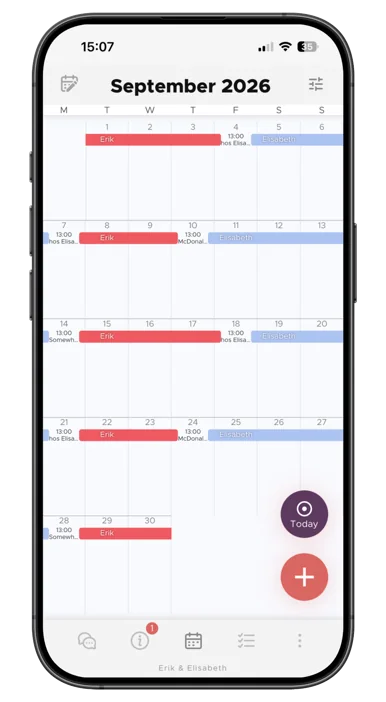
"The turning point came when we found the Co-parenting app. There's less fuss and both of us have a better handle on things. It feels so great!”
"Thank you so much for this app, it has finally gotten us to communicate!”

Practical Matters
Where and when to do custody exchanges, who drives, what travels with the child, what to do when a parent is late, and a sample exchange clause.
Cooperation
A parenting plan checklist: the regular schedule, holidays, exchanges, decisions, communication, expenses, travel and how to change the plan later.

Cooperation
Hostile texts and emails to your co-parent reach your child even if they never read them. Child psychologist Malin Bergström explains why — and what helps.