





England
Cooperation
Making a Parenting Plan in England
A clear plan can reduce last-minute messages and misunderstandings. Here is what a parenting plan can cover in England, and how it differs from a court order.
After a separation, one parent — often the mother — carries most of the practical responsibility for the children, while the other feels their way of caring isn't fully trusted. Rebalancing that takes real effort: one of you may need to step up, and the other to let go.

If you're the parent stepping up, focus on building your competence and confidence — and on deepening your relationship with your child. Feeling awkward at first doesn't disqualify you as a parent; we've all been there. You don't need to put on a front and pretend to know more than you do. What matters is that you try, and that you show up with love and care.
If your co-parent tends to be bossy or controlling, ask them to be patient. The need for control may come from caring, not from wanting to undermine you. And don't hesitate to seek help — everything you do for your child's sake is something to be proud of. If you're brave enough to own your insecurity, you can ask your co-parent for advice. You can also turn to your BVC nurse (at the Swedish child health center) if your child is little, or join a parent support program run by your kommun (municipality) if you have school-aged children. Society invests significant resources in helping parents do this job as well as we can.
Don't worry — you can do this. Learning to let go when you've always been in charge can be just as hard as stepping up when you're used to riding in the back seat. Not being on hand when you always have been can bring both anxiety and sadness.
If it helps you feel secure, an agreed update about how your child is doing can make daily life easier. For a young child, that might be a photo or a short message, where sharing is safe and appropriate. Predictable communication can reduce repeated checking. Practical boundaries need to fit the child’s needs and any applicable agreement or court order; a parent’s wish for updates does not by itself determine a legal right to contact at any time.
Booking a check-in with each other two or three months ahead can create calm and give you both some breathing room. Are you heading in the right direction, or not?
Malin Bergström Child psychologist, associate professor and author
17 September 2026
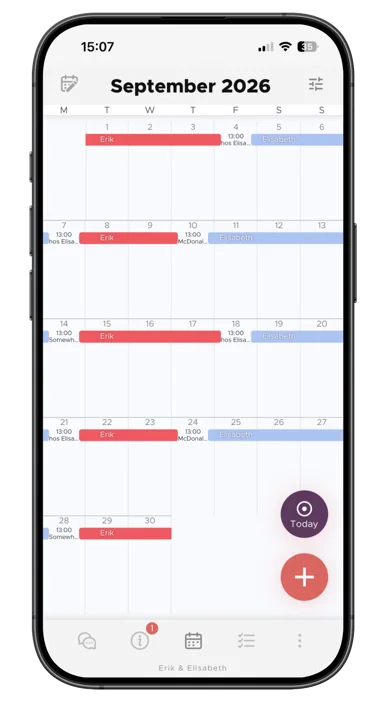
"The turning point came when we found the Every Other Week app. There's less fuss and both of us have a better handle on things. It feels so great!”
"Thank you so much for this app, it has finally gotten us to communicate!”

England
Cooperation
A clear plan can reduce last-minute messages and misunderstandings. Here is what a parenting plan can cover in England, and how it differs from a court order.
United States
Cooperation
A written plan can reduce uncertainty about school weeks, holidays and handovers. In the United States, its legal effect depends on your state and whether the court has approved it.
Canada
Cooperation
A parenting plan puts the everyday arrangements in one place. For families in Canada, a useful plan explains both the weekly routine and how bigger decisions will be made.

Cooperation
Summer planning when you share custody: start early, agree on the holiday weeks, swap days when you need to, and balance old traditions with new ones.

Separation
Separating with children? A checklist of what to sort out first: where everyone lives, the schedule, handovers, money, sick days, and what to tell the kids.