




Housing & practical matters
Birthdays, Mother's Day and Father's Day
How to handle the children's birthdays, the parents' birthdays, Mother's Day and Father's Day in two homes, with the dates for 2026 to 2030.
Thanksgiving 2026 falls on Thursday, November 26, 2026. If you are working out who has the children this year, here are the five arrangements parents use most, what each means in time, and the dates through 2030.
The short version
| Year | US Thanksgiving (fourth Thursday of November) | Canadian Thanksgiving (second Monday of October) | Alternating by year: who has it |
|---|---|---|---|
| 2026 | Thursday, Nov 26 | Monday, Oct 12 | Parent A |
| 2027 | Thursday, Nov 25 | Monday, Oct 11 | Parent B |
| 2028 | Thursday, Nov 23 | Monday, Oct 9 | Parent A |
| 2029 | Thursday, Nov 22 | Monday, Oct 8 | Parent B |
| 2030 | Thursday, Nov 28 | Monday, Oct 14 | Parent A |
Many US schools close for part or all of Thanksgiving week, from two days to five. Check your district's calendar, and write the arrangement around the days school is actually out.
| Arrangement | How it works | Time with the Thanksgiving parent |
|---|---|---|
| Alternate the day | Thursday morning to Friday morning with one parent, alternating each year. | About 24 hours (one night) |
| Alternate the long weekend | Wednesday after school to Sunday at 6 p.m., alternating each year. | Four nights (Wednesday to Saturday) |
| Split the day | Morning with one parent, the meal and evening with the other, swapping each year. | Half the day each |
| Pair it with winter break | One parent has Thanksgiving, the other the first half of winter break, swapping each year. | A long weekend, traded for part of another break |
| Celebrate twice | One parent celebrates on Thursday, the other on Friday or Saturday, every year. | One day each, every year |
Alternating by year is the most common arrangement, and the easiest to remember. Alternating the whole long weekend suits parents who live far apart or travel to family, because a single day is not worth the drive. The cost is a Thanksgiving without the children every other year.
Both parents see the children every Thanksgiving. It works when the homes are close and handovers are calm; with a long drive or a tense exchange, it can take over the day.
Trading Thanksgiving against part of winter break keeps the big holidays balanced across the year: whoever misses Thanksgiving gets the longer stretch in December.
Some families make the second Thanksgiving a tradition of its own — Friday leftovers at one home, Thursday dinner at the other. Children often enjoy two celebrations more than parents expect.
With the holiday close, the most useful thing is to put whatever you agree in writing now: the start and end times, where the exchange happens, and who drives. If your plan already says how holidays work, follow it. If it says nothing, a one-off agreement for this year — "you this year, me next year" — written down, beats an argument in Thanksgiving week. If there is a court order, follow it; if you both want to do something different, agree in writing and check with your lawyer.
Public holidays are filled in for where you live, and you can import your child's actual school holidays — the dates the school has published — for almost every school across North America, the EU and Australia. See how to import a school calendar, then check the dates it finds against the school's own information.
The Thanksgiving arrangement goes into the schedule as a proposal: change the days directly, or apply a template between two dates — a different rotation for the summer, for example. Nothing changes until the other parent accepts it, and once the schedule is active, every change is a request the other parent has to accept. The FAQ has more on schedules and change requests.
Whoever the parenting plan says. The most common arrangement is alternating by year, with one parent in even-numbered years and the other in odd-numbered years. If there is no plan, agree this year in writing.
The common ways are alternating the day or the long weekend by year, splitting the day, pairing Thanksgiving with part of winter break, or celebrating on two days.
In most plans, holidays override the regular rotation, which then carries on afterwards. Your plan should say so.
Alternating the whole long weekend, from Wednesday to Sunday, is usually more practical than a split day. Say whether travel time comes out of the holiday.
Thursday, November 26, 2026. In 2027 it is Thursday, November 25, 2027.
The second Monday of October: Monday, October 12, 2026, and Monday, October 11, 2027.
6 November 2026
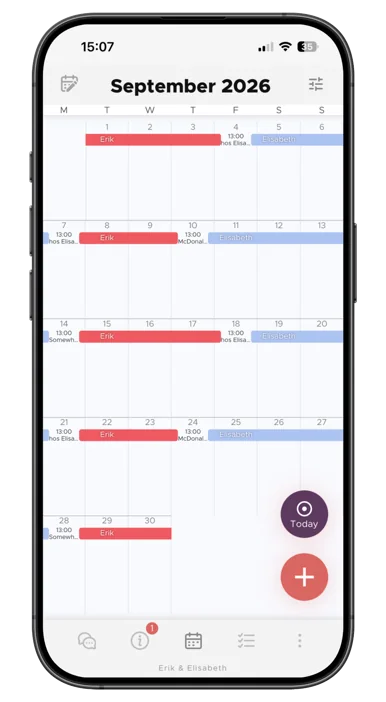
"The turning point came when we found the Co-parenting app. There's less fuss and both of us have a better handle on things. It feels so great!”
"Thank you so much for this app, it has finally gotten us to communicate!”

Housing & practical matters
How to handle the children's birthdays, the parents' birthdays, Mother's Day and Father's Day in two homes, with the dates for 2026 to 2030.
Housing & practical matters
How to split Christmas Eve, Christmas Day and winter break between two homes, with the days of the week for 2026 to 2030 and a worked example.
Housing & practical matters
How to split holidays between two homes: alternating years, split days, fixed holidays and divided breaks, with an even/odd-year example for 2026 to 2030.