




Housing & practical matters
Birthdays, Mother's Day and Father's Day
How to handle the children's birthdays, the parents' birthdays, Mother's Day and Father's Day in two homes, with the dates for 2026 to 2030.
School breaks are long enough to change the shape of a whole year. Here is how families usually divide spring break and summer, what a summer rotation does to the number of nights, and the deadlines that stop the planning from starting in June.
The short version
| Year | Easter Sunday |
|---|---|
| 2026 | Sunday, April 5, 2026 |
| 2027 | Sunday, March 28, 2027 |
| 2028 | Sunday, April 16, 2028 |
| 2029 | Sunday, April 1, 2029 |
| 2030 | Sunday, April 21, 2030 |
| Arrangement | How it works | Often suits |
|---|---|---|
| Keep the regular rotation | The school-year schedule continues; vacations are taken inside it or by swapping. | Families on a 50/50 schedule who live close |
| A summer rotation | A different rotation for the summer, often alternating weeks. | Families whose school-year schedule is every other weekend or otherwise uneven |
| Vacation weeks | Each parent may take one to three uninterrupted weeks, chosen by a deadline. | Almost everyone, on top of one of the others |
| Halves | The first half of the summer with one parent, the second with the other, alternating by year. | Long distances, or older children who manage long blocks |
| Most of the summer with one parent | The parent with less time during the school year has most of the summer. | Long-distance families |
On an every-other-weekend schedule, the weekend parent has 2 of every 14 nights — about 52 nights a year. Switching to alternating weeks for a ten-week summer gives that parent 35 nights in the summer alone, and takes the year to about 77 nights, or 21%. On a 50/50 schedule a summer rotation changes the shape of the summer, not the total.
Overnight counts can matter for child support and for some court decisions, so if the numbers are part of what you are weighing, check how they are used where you live. Custody schedule examples explains how to count overnights.
A typical clause lets each parent take up to two consecutive weeks of vacation with the children during the summer, chosen in writing by a set date in the spring. In even-numbered years one parent chooses first; in odd-numbered years the other. The details worth writing down:
Summer is when the extra costs pile up: camps, childcare and activities that run in only one home's weeks. Agree who books what, how the costs are split, and how each parent learns the schedule. In the app, the Finance Assistant keeps the children's costs in one place and splits them the way you agreed. Read keeping track of your child's costs in two homes.
For the conversation itself — starting early, compromising, putting the children first — read summer planning with shared custody.
Public holidays are filled in for where you live, and you can import your child's actual school holidays — the dates the school has published — for almost every school across North America, the EU and Australia. See how to import a school calendar, then check the dates it finds against the school's own information.
The summer arrangement goes into the schedule as a proposal: change the days directly, or apply a template between two dates — a different rotation for the summer, for example. Nothing changes until the other parent accepts it, and once the schedule is active, every change is a request the other parent has to accept. The FAQ has more on schedules and change requests.
Most often it is alternated by year, with the whole break going to one parent in even-numbered years and the other in odd-numbered years. On a 50/50 schedule, some families leave it inside the regular rotation.
Families keep the regular rotation, switch to a summer rotation such as alternating weeks, give each parent uninterrupted vacation weeks, or split the summer in halves. Many combine a rotation with vacation weeks.
A date in the plan, often in the spring, by which each parent chooses their vacation weeks in writing. It stops summer planning from turning into a last-minute negotiation.
Yes. Write down the start and end dates and the summer rotation, and what happens when school starts again.
It can. Switching an every-other-weekend schedule to alternating weeks for a ten-week summer takes the weekend parent from about 52 to about 77 nights a year. On a 50/50 schedule the total stays the same.
6 November 2026
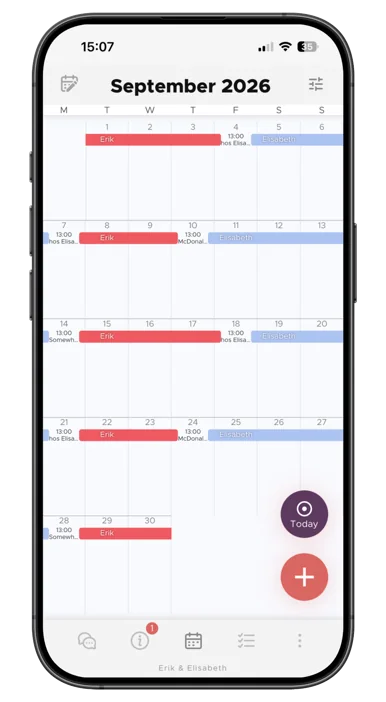
"The turning point came when we found the Co-parenting app. There's less fuss and both of us have a better handle on things. It feels so great!”
"Thank you so much for this app, it has finally gotten us to communicate!”

Housing & practical matters
How to handle the children's birthdays, the parents' birthdays, Mother's Day and Father's Day in two homes, with the dates for 2026 to 2030.
Housing & practical matters
How to split Christmas Eve, Christmas Day and winter break between two homes, with the days of the week for 2026 to 2030 and a worked example.
Housing & practical matters
How to split holidays between two homes: alternating years, split days, fixed holidays and divided breaks, with an even/odd-year example for 2026 to 2030.