





Separation
Check In With Yourself During a Separation
Taking care of yourself matters during a separation. Four calm questions to check in with yourself, plus small routines for home, food, exercise, and work.
When parents stop communicating, there is always a deep conflict behind the silence. It's often the child who pays the price — pushed into carrying an adult relationship they have no power over.

Building an okay co-parenting relationship after a separation can be hard. You want to move on, but the same conflicts keep repeating, and the focus lands on the parents instead of the child. For some, it feels so hopeless that not communicating at all seems like the better option: "It's not working anyway! If we don't talk, at least there's no fighting — just peace and quiet." Or is there?
Yes, you can. Even after a separation, it's natural — and important — for parents to communicate. Some talk on the phone often; others send short chat messages or texts now and then. Never communicating at all, even though you share children under eighteen, is a sign of underlying conflict. And it's these unresolved conflicts, building up over time, that harm children (and parents). A prolonged, stubborn silence between parents is just as much a conflict as parents yelling at each other. The "permafrost" conflict simply shows itself differently — through a palpable silence and a bad atmosphere.
When adults don't take responsibility for the parental relationship and stop communicating and cooperating, the job of planning and communicating shifts onto the child. It's as if the parent quietly resigns from the part of parenthood that involves helping the child with their relationships.
For the child, the parents' conflict "moves into" their life and becomes something they have to deal with every day. Being cast as messenger or mediator between parents can bring stress, guilt and anxiety. In the long run it's unsustainable, because the child can never "win" or "succeed" — the solution to the conflict never lies with the child, only with the parents. Parents can help by resuming communication with each other and taking back responsibility for the child's everyday life.
A good starting point is to find communication channels that work — with your co-parent, and with your child as they grow older and more independent. Whatever your child's age, you and your co-parent need channels of your own. Just knowing you can reach each other without conflict is usually good for the child.
You know your co-parent, and you probably have a fair idea of what lies behind the conflicts and the silence. What solutions can you see for the future?
When communication has stopped completely, the app can be a flexible way to start again — with the focus entirely on the child, and enough distance between you parents that no new conflicts flare up. Try inviting your co-parent to the app. They may also want a change, for the child's sake.
Your child needs to know that the silence between their parents is not their fault. They also need room to talk about what's happening — and for us adults to set our own needs aside and listen. The goal isn't to present quick fixes. It's to show that we're there, that we understand, and that we're doing what we can to get communication with the co-parent working.
You can only take responsibility for your own actions in melting the permafrost. And remember: children notice when parents make an effort — it means a lot!
Malin Bergström Child psychologist, associate professor and author
27 August 2026
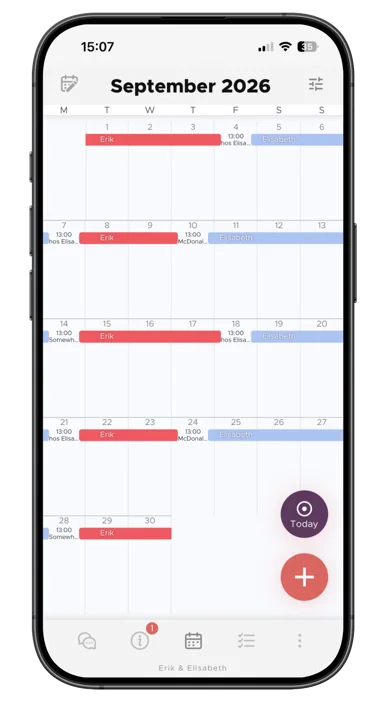
"The turning point came when we found the Every Other Week app. There's less fuss and both of us have a better handle on things. It feels so great!”
"Thank you so much for this app, it has finally gotten us to communicate!”

Separation
Taking care of yourself matters during a separation. Four calm questions to check in with yourself, plus small routines for home, food, exercise, and work.

Cooperation
Good communication is the backbone of co-parenting — but sometimes one or both parents cross the line of what's acceptable, occasionally or as a recurring pattern. How do you tell ordinary disagreement from real insults, and when does it become destructive?

Cooperation
Practical ways to reduce conflict with your co-parent: keep your agreements, use I statements, stay out of their parenting and help out when you can.