




Housing & practical matters
2-2-5-5 Custody Schedule (Also 5-2-2-5)
The 2-2-5-5 custody schedule, also called 5-2-2-5 or 2-5-5-2: a two-week calendar, overnights per year, exchanges, pros and cons, and who it suits.
In a 2-2-3 schedule the child never goes more than three nights without seeing a parent. The trade-off is more handovers: six every two weeks. Here is how the rotation runs, and what it asks of both households.
The 2-2-3 schedule at a glance
The name describes the blocks in the first week: two nights with one parent, two with the other, then three nights with the first parent again. In the second week the roles swap: parent B has Monday and Tuesday, parent A has Wednesday and Thursday, and parent B has the weekend. Over two weeks each parent has seven nights, and the child changes homes three times as often as in alternating weeks.
| Week | Mon | Tue | Wed | Thu | Fri | Sat | Sun |
|---|---|---|---|---|---|---|---|
| 1 | A | A | B | B | A | A | A |
| 2 | B | B | A | A | B | B | B |
In the grid, parent A has Monday–Tuesday and Friday–Sunday in week 1, and Wednesday–Thursday in week 2. Parent B has the mirror image. No block is longer than three nights, and because the rotation swaps every week, each parent has every day of the week once in the two-week cycle.
Each parent has 7 of 14 nights: 50%, about 182 to 183 nights a year. Weekend nights (Friday and Saturday) are shared evenly too: 2 each over a full rotation.
It is a common choice for babies, toddlers and younger school-age children, because of the short gaps, and for parents who live near each other and communicate reasonably well. It is a poorer fit where handovers are tense, where the homes are far apart, or where a parent's work makes a regular midweek exchange hard. If conflict at exchanges is the main worry, alternating weeks has a third as many.
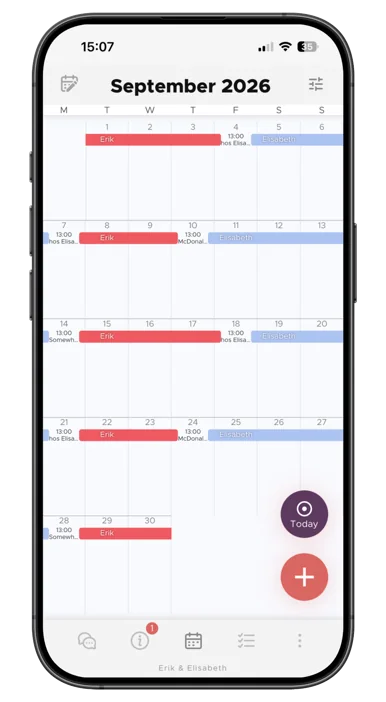
the 2-2-3 schedule is one of the schedule templates in the app. Pick it in the calendar, choose the date the first rotation starts, and see how it falls across the year before you send it to your co-parent.
A schedule is only a proposal until the other parent accepts it, so you can try it out without committing either of you to anything. Once it is active, neither of you can change it on your own: every change is a request the other parent has to accept, and what you both see in the calendar is always what you both agreed to.
School holidays and public holidays are filled in for where you live, so you can see where the rotation runs into spring break or a long weekend while it is still a proposal. The FAQ covers templates, change requests and holidays in more detail.
Prefer fewer exchanges? Look at 2-2-5-5, which keeps the 50/50 split with 4 exchanges instead of 6, or alternating weeks. For the comparison table, see custody schedule examples.
A 50/50 rotation in which one parent has the child for two nights, the other for two nights, and then the first parent for three nights; the next week the pattern is mirrored. Each parent ends up with seven nights out of every 14.
Seven of every 14 nights, which is 50%. Over a year that is about 182 or 183 nights each.
No. Both are 50/50 and both are built from two-night blocks, but 2-2-5-5 keeps the weekdays fixed and alternates five-night blocks, so it has 4 exchanges every two weeks instead of 6 and a longest stretch of 5 nights instead of 3.
Its short gaps are the main reason it is commonly suggested for toddlers: the child is never more than three nights from either parent. The many handovers are the cost, so it works best when the parents live close and handovers are calm.
The regular rotation usually pauses for holidays and school breaks, and a separate rule decides who has the child — alternating years for major holidays and splitting longer breaks are the common approaches. The rotation then resumes.
2 November 2026
"The turning point came when we found the Co-parenting app. There's less fuss and both of us have a better handle on things. It feels so great!”
"Thank you so much for this app, it has finally gotten us to communicate!”

Housing & practical matters
The 2-2-5-5 custody schedule, also called 5-2-2-5 or 2-5-5-2: a two-week calendar, overnights per year, exchanges, pros and cons, and who it suits.
Housing & practical matters
How the 3-4-4-3 custody schedule works, also called 4-3-3-4: a two-week calendar, why the start day decides who gets the weekends, pros and cons.
Housing & practical matters
How a week-on/week-off custody schedule works: the 7-7 rotation, overnights per year, the longest stretch away, pros and cons, and who it tends to suit.