




Housing & practical matters
2-2-3 Custody Schedule: How It Works
The 2-2-3 custody schedule explained with a two-week calendar: overnights per year, exchanges, pros and cons, and which ages it tends to suit.
The child spends a full week with one parent, then a full week with the other. It is the simplest 50/50 rotation to explain and the one with the fewest exchanges, and also the one with the longest stretch away from each parent.
The alternating weeks schedule at a glance
One parent has the child for seven nights in a row, the other parent for the next seven, and the pattern repeats. The exchange can happen on any day. Many families pick Friday after school or Sunday evening, so the child starts the week at the home they will leave for school from; others choose Monday morning at school so the parents do not have to meet at all.
| Week | Mon | Tue | Wed | Thu | Fri | Sat | Sun |
|---|---|---|---|---|---|---|---|
| 1 | A | A | A | A | A | A | A |
| 2 | B | B | B | B | B | B | B |
This grid starts the rotation on a Monday with parent A. Move the exchange to another day and the pattern is the same, just shifted: each parent still has the child for a full week and then goes a full week without.
Each parent has 7 of every 14 nights, which is 50% and about 182 to 183 nights a year. Because the rotation is perfectly even over two weeks, holidays are the only thing that pulls the yearly count away from 182.5, which is why most families add a rule for who has the child during school breaks.
It is often a good fit for school-age children and teenagers, for parents who live close enough to the school that either home works for a whole week, and for parents who want as few handovers as possible. It is a harder fit for babies and toddlers, who generally do better with shorter blocks, and for families whose work makes a full week of sole care difficult. Our article on shared parenting for babies and toddlers covers the youngest ages.
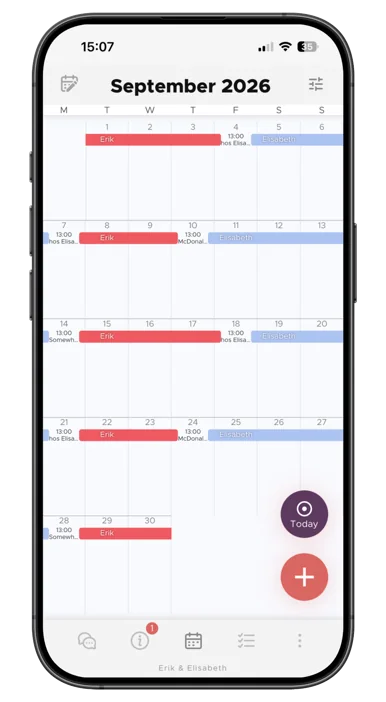
alternating weeks is one of the schedule templates in the app. Pick it in the calendar, choose the date the first rotation starts, and see how it falls across the year before you send it to your co-parent.
A schedule is only a proposal until the other parent accepts it, so you can try it out without committing either of you to anything. Once it is active, neither of you can change it on your own: every change is a request the other parent has to accept, and what you both see in the calendar is always what you both agreed to.
School holidays and public holidays are filled in for where you live, so you can see where the rotation runs into spring break or a long weekend while it is still a proposal. The FAQ covers templates, change requests and holidays in more detail.
If the long stretches are the worry, look at 2-2-3 (no more than 3 nights away) or 2-2-5-5 (no more than 5). For the full side-by-side comparison, see custody schedule examples.
A schedule where the child spends one full week with one parent and the next full week with the other, repeating. It is also called week on/week off or a 7-7 schedule.
It can be hard on very young children because of the seven nights between seeing a parent. Many families with babies and toddlers choose shorter blocks, such as 2-2-3, and move to longer ones as the child grows. It depends on the child and on how much contact the parent can have in between.
Any day works. Friday after school and Sunday evening are common because they match the weekend, and a Monday exchange at school means the parents do not have to meet. Pick the one that gives the child the smoothest start to the school week.
There is one exchange a week, about 52 a year, which is the lowest of the common 50/50 schedules.
The weekly rotation normally pauses for holidays. Common approaches are alternating major holidays each year and splitting school breaks into blocks, with the weekly rotation resuming afterward. Put the rule in writing so it is not renegotiated each time.
2 November 2026
"The turning point came when we found the Co-parenting app. There's less fuss and both of us have a better handle on things. It feels so great!”
"Thank you so much for this app, it has finally gotten us to communicate!”

Housing & practical matters
The 2-2-3 custody schedule explained with a two-week calendar: overnights per year, exchanges, pros and cons, and which ages it tends to suit.
Housing & practical matters
The 2-2-5-5 custody schedule, also called 5-2-2-5 or 2-5-5-2: a two-week calendar, overnights per year, exchanges, pros and cons, and who it suits.
Housing & practical matters
How the 3-4-4-3 custody schedule works, also called 4-3-3-4: a two-week calendar, why the start day decides who gets the weekends, pros and cons.