





Cooperation
How Toxic Messages to Your Co-Parent Affect Your Child
Hostile texts and emails to your co-parent reach your child even if they never read them. Child psychologist Malin Bergström explains why — and what helps.
It's hard for children when their parents argue. Even when conflict can't be avoided, you can help your child feel safe and make sense of what's happening — child psychologist Malin Bergström explains how.

When we talk about what is going on in our lives, we help children understand what they are experiencing in their family and with us as parents.
If there is conflict between you as parents, it is often wise to acknowledge it to your child. Children can understand that when people are angry, they sometimes say and do foolish things they don't mean — and that it can affect others even when that was never the intention.
Children need to hear that adults are always responsible for their own actions and arguments. It is never the child's job to resolve them, no matter what the conflict is about.
You can say something like: "Even though we as parents don't get along right now, it's our job to fix that — not yours. And the reason we don't get along has nothing to do with you." Acknowledge that you see how your adult conflicts affect your child.
A little tact goes a long way here. Talk about what is happening without going into details or burdening your child with too much information about your adult relationship. Oversharing can pull the child into the conflict instead of protecting them from it.
Avoid using the child as a sounding board for adult grievances. This does not mean concealing abuse or dismissing a child's account of harm; safety concerns should be acknowledged and appropriate support involved.
For your child to confide in you, you need to set your own needs aside and listen. When you listen, focus on your child and their needs rather than your own situation. An adult who shows empathy and can reason and see the bigger picture is a huge help — especially if the child's own relationship with the other parent is difficult.
When our own lives are hard, we adults can forget to talk to our children. We may also be afraid to ask how they are doing because we don't want to hear that they might be sad or upset. It can feel easier to tell ourselves not to intrude — surely the child will come to us if they need something. But research shows that children want us to ask and to show that we care, again and again and again. Talking with your child helps you understand how to support and protect them, and it makes them feel less alone if they are struggling.
For some children, parental conflict and separation are so hard that they cannot feel okay without outside help. Sometimes it is a combination of things happening at home and at school or with friends. In that case, help your child talk to an outside adult with experience counseling children. In Sweden, possible support routes include school health services, youth clinics (ungdomsmottagningar) and BUP (child and adolescent psychiatry). Access and referral requirements vary; the country comparison describes support routes elsewhere.
Malin Bergström Child psychologist, associate professor and author
17 September 2026
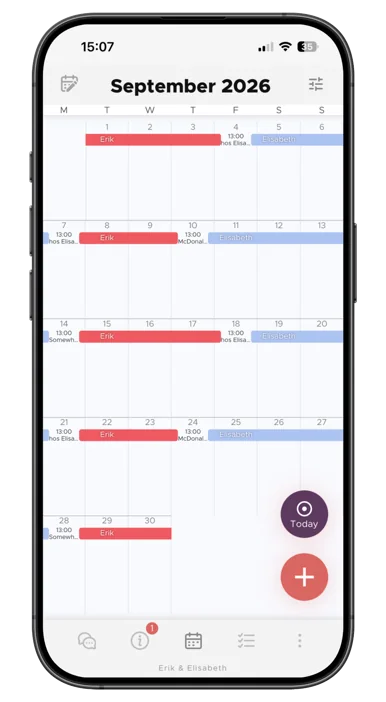
"The turning point came when we found the Co-parenting app. There's less fuss and both of us have a better handle on things. It feels so great!”
"Thank you so much for this app, it has finally gotten us to communicate!”

Cooperation
Hostile texts and emails to your co-parent reach your child even if they never read them. Child psychologist Malin Bergström explains why — and what helps.

England
Cooperation
A clear plan can reduce last-minute messages and misunderstandings. Here is what a parenting plan can cover in England, and how it differs from a court order.
United States
Cooperation
A written plan can reduce uncertainty about school weeks, holidays and handovers. In the United States, its legal effect depends on your state and whether the court has approved it.
Canada
Cooperation
A parenting plan puts the everyday arrangements in one place. For families in Canada, a useful plan explains both the weekly routine and how bigger decisions will be made.

Cooperation
Summer planning when you share custody: start early, agree on the holiday weeks, swap days when you need to, and balance old traditions with new ones.