




Housing & practical matters
2-2-3 Custody Schedule: How It Works
The 2-2-3 custody schedule explained with a two-week calendar: overnights per year, exchanges, pros and cons, and which ages it tends to suit.
In an every-other-weekend schedule the child lives mainly in one home, and spends alternate weekends with the other parent. How much time that adds up to depends on how the weekend is defined and whether a midweek overnight is added.
The every other weekend schedule at a glance
The weekend parent has the child from Friday after school until Sunday evening (or Monday morning) every second weekend. The other parent has the child the rest of the time, including the other weekends. It is the arrangement that most people picture when they hear "visitation", and it is widely used when children live mainly in one home because of distance, work patterns or an existing routine.
| Week | Mon | Tue | Wed | Thu | Fri | Sat | Sun |
|---|---|---|---|---|---|---|---|
| 1 | A | A | A | A | A | A | A |
| 2 | A | A | A | A | B | B | A |
In the grid, parent B (the weekend parent) has the child on Friday and Saturday nights of week 2, and parent A has every other night. There are two exchanges in the two-week cycle, and the longest the weekend parent goes without a night with the child is 12 nights.
| Variation | Nights for the weekend parent, per 14 | Share of nights | About, per year |
|---|---|---|---|
| Friday and Saturday nights, every other weekend | 2 | 14.3% | 52 |
| Friday, Saturday and Sunday nights (back Monday morning) | 3 | 21.4% | 78 |
| Friday and Saturday nights, plus one midweek overnight each week | 4 | 28.6% | 104 |
| Three weekend nights, plus one midweek overnight each week | 5 | 35.7% | 130 |
Adding a weekly midweek overnight is the most common way families lift the weekend parent's share without changing the main home. A mid-week dinner without the overnight keeps contact frequent but does not change the count.
It is often chosen when the parents live too far apart for a school-week rotation, when one parent's work (shifts, travel) makes weekdays impractical, or when the child has lived mainly in one home so far. Many families treat it as a starting point and add midweek time as circumstances change. Children's needs change as they grow, so build in a review date.
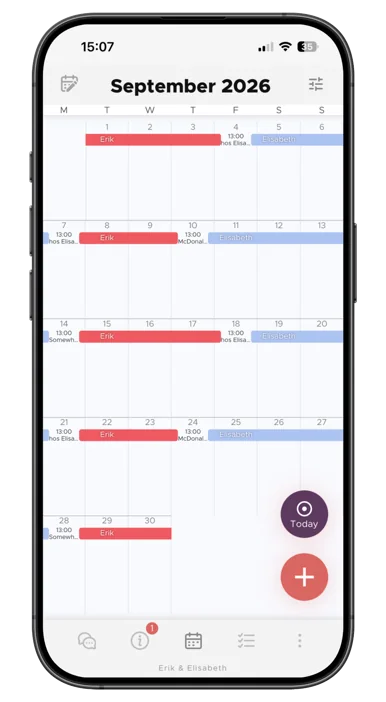
every other weekend is one of the schedule templates in the app. Pick it in the calendar, choose the date the first rotation starts, and see how it falls across the year before you send it to your co-parent.
A schedule is only a proposal until the other parent accepts it, so you can try it out without committing either of you to anything. Once it is active, neither of you can change it on your own: every change is a request the other parent has to accept, and what you both see in the calendar is always what you both agreed to.
School holidays and public holidays are filled in for where you live, so you can see where the rotation runs into spring break or a long weekend while it is still a proposal. The FAQ covers templates, change requests and holidays in more detail.
If you want something closer to even, look at 2-2-5-5 or 3-4-4-3; for the lowest number of exchanges among the 50/50 options, alternating weeks. All are compared in custody schedule examples.
With Friday and Saturday nights only, 2 of every 14 nights, which is 14.3% or about 52 nights a year. With Sunday night too (returning Monday morning), it is 3 of 14, about 78 a year.
No. It gives the weekend parent a small share of the nights unless it is combined with substantial midweek and holiday time.
Two weekend nights and one midweek overnight each week gives 4 of 14 nights, 28.6%, about 104 a year. With three weekend nights it is 35.7%, about 130.
Holidays and school breaks normally override the weekend rotation, often alternating major holidays each year and giving the weekend parent a block of the summer. Write the rule down so it does not have to be renegotiated each time.
Yes — families commonly add midweek time or move toward a more even split as children grow and circumstances change. If there is a court order, changes may need to be agreed formally; check with a family lawyer where you live.
2 November 2026
"The turning point came when we found the Co-parenting app. There's less fuss and both of us have a better handle on things. It feels so great!”
"Thank you so much for this app, it has finally gotten us to communicate!”

Housing & practical matters
The 2-2-3 custody schedule explained with a two-week calendar: overnights per year, exchanges, pros and cons, and which ages it tends to suit.
Housing & practical matters
The 2-2-5-5 custody schedule, also called 5-2-2-5 or 2-5-5-2: a two-week calendar, overnights per year, exchanges, pros and cons, and who it suits.
Housing & practical matters
How the 3-4-4-3 custody schedule works, also called 4-3-3-4: a two-week calendar, why the start day decides who gets the weekends, pros and cons.