




England
Youth
Can I Choose Which Parent to Live with in England?
You are allowed to say how living in two homes feels. If you live in England, adults should listen to your views—but you do not have to solve your parents’ disagreement.
When parents are caught up in their own worries and all the practical things that come with a divorce, it’s easy for a child to feel a bit overlooked. A simple question like “How are you?” from a parent can make everything feel a little better, even just for a moment.
If your parents are splitting up, it can help to know a few things about divorce and how people usually react — both kids and parents. At Co-parenting, we’ve put together some tips and articles that we hope will support you while your parents go through this change.

One thing is true for all families: It’s never the child’s fault when parents decide to divorce!
- Malin Bergström, Child Psychologist
It’s common for things to feel chaotic when parents get divorced. Everyone in the family might be struggling at the same time. There are also many practical changes to deal with—moving, possibly switching schools, and getting used to not seeing both parents at the same time. It’s easy to think that life and your family will be chaotic forever. But luckily, that’s not the case. On the other side of the divorce, there’s a new normal. It’s different, but it doesn’t have to be worse. Most parents decide to divorce because they want the family to function better. It can be hard to hold onto that hope when everything is upside down, but for most kids, things do get better after a while.
Some kids wonder if they did something that caused their parents to want to separate. But that’s not true. A divorce is always about how the parents are getting along with each other. Sometimes it’s about their relationship as a couple—they might argue, not have fun together, want different things, or struggle to feel relaxed and happy together. Other times, it’s more about how they handle parenting and the challenges that come with it.
Some parents feel like they’re doing everything on their own, while others feel the other parent is too controlling and think it would be easier if they could just make decisions on their own. There are almost as many reasons for divorce as there are families. But one thing is true for all families: It’s never the child’s fault when parents decide to divorce.
When everything is hectic and chaotic in the family, it’s important to have moments of peace together—ideally every day. When nothing else feels normal, it’s even more important to have at least one thing that stays the same. Maybe it’s having your favorite breakfast sandwich to start the day calmly, with a feeling that at least something is as it should be. Maybe it’s having a snack together in the evening and talking about the day, or having your parent sit by your bed at night, like they did when you were younger. When life is tough, these small routines become important. And it means a lot when parents take the time to ask, “How are you?”
When your parents are divorcing, you might not even know where you’ll be living or how often you’ll get to see each parent. If you’re feeling worried and sad, it’s extra important to have a place where you can retreat, somewhere you feel safe. For many, that place is their bed. It can also help to figure out activities that make you feel calm. Maybe you relax by watching something on your phone or computer. Maybe it helps if someone gives you a massage or scratches your back. For some, imagining a cozy place or remembering nice things you’ve done can make a difference. Finding your safe place and the activities that comfort you can make you feel less anxious and help create a sense of security.
Malin Bergström Child psychologist, associate professor and author
27 August 2026
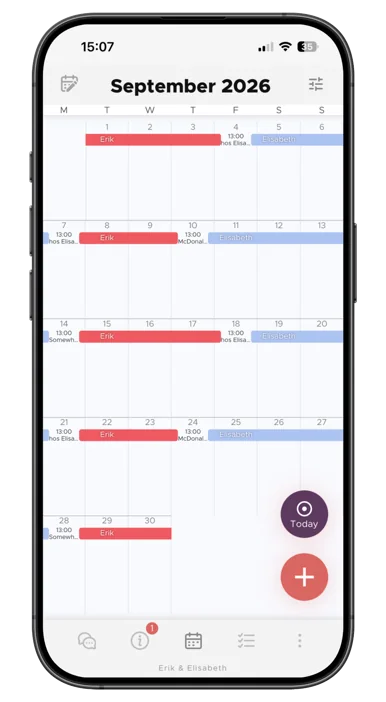
"The turning point came when we found the Co-parenting app. There's less fuss and both of us have a better handle on things. It feels so great!”
"Thank you so much for this app, it has finally gotten us to communicate!”

England
Youth
You are allowed to say how living in two homes feels. If you live in England, adults should listen to your views—but you do not have to solve your parents’ disagreement.

England
Youth
You deserve care, safety and someone who listens. If something at home feels frightening or hurts you, you can ask for help—even when the person involved is a parent.

England
Youth
You might feel sad, angry, relieved or unsure what you feel. If you live in England, there are people who can listen. You do not have to wait until things feel unbearable.
United States
Youth
You can tell adults what living in two homes feels like. In the United States, how a court hears children depends on the state. You are not responsible for deciding your parents’ dispute.
United States
Youth
You deserve care and protection from harm. If someone at home hurts you, threatens you or leaves you without the care you need, you can tell a safe adult.
United States
Youth
You may be worried, angry, relieved or not sure what you feel. If your parents are separating, you can ask someone to listen. You do not have to handle it alone.
Canada
Youth
You can say what life in two homes feels like. If you live in Canada, adults should listen to your views. You do not have to settle the disagreement between your parents.
Canada
Youth
You deserve care and protection from harm. If something at home hurts or frightens you, you can ask for help. You do not need to know the law before talking to a safe adult.
Canada
Youth
Changing homes or hearing your parents argue can feel like a lot to carry. If you live in Canada, you can ask someone to listen—even when there is no emergency or court case.